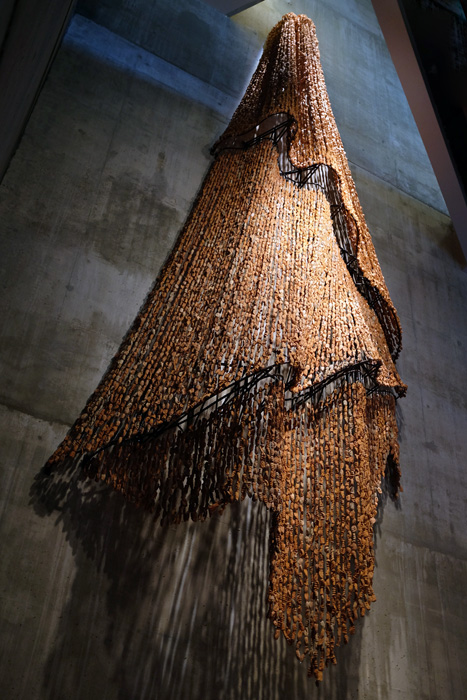
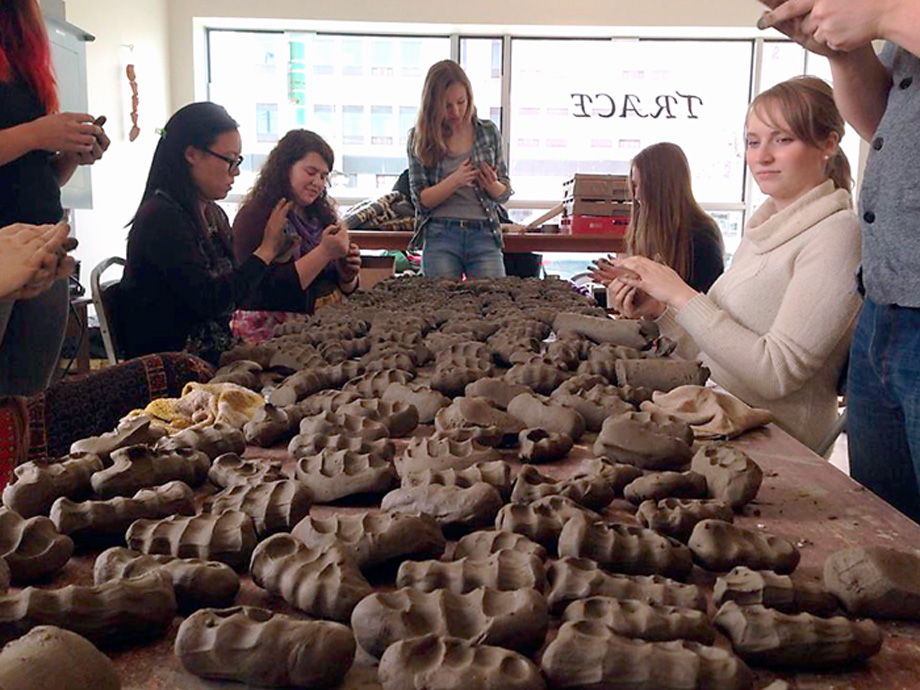
2014 / with Osvaldo Yero / Canadian Museum for Human Rights, Winnipeg, MB / Sculpture / Community project
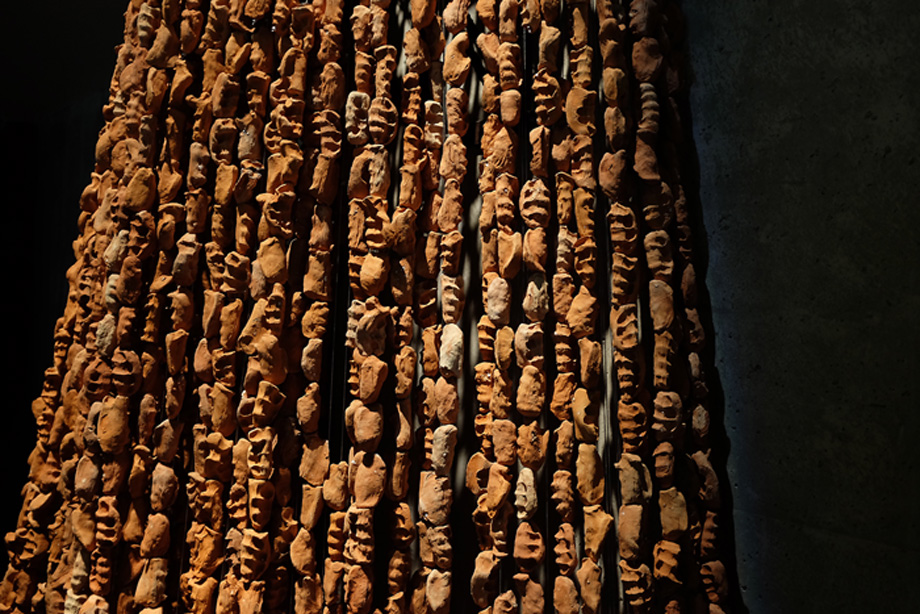
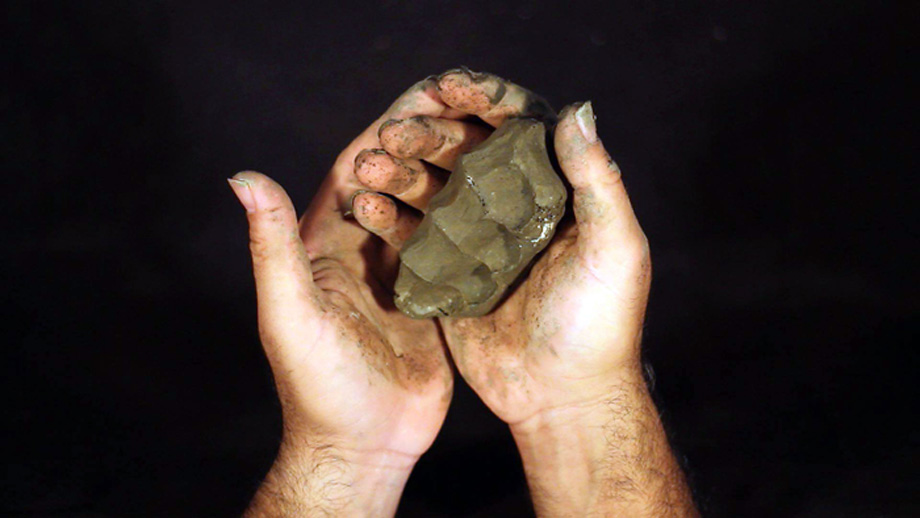
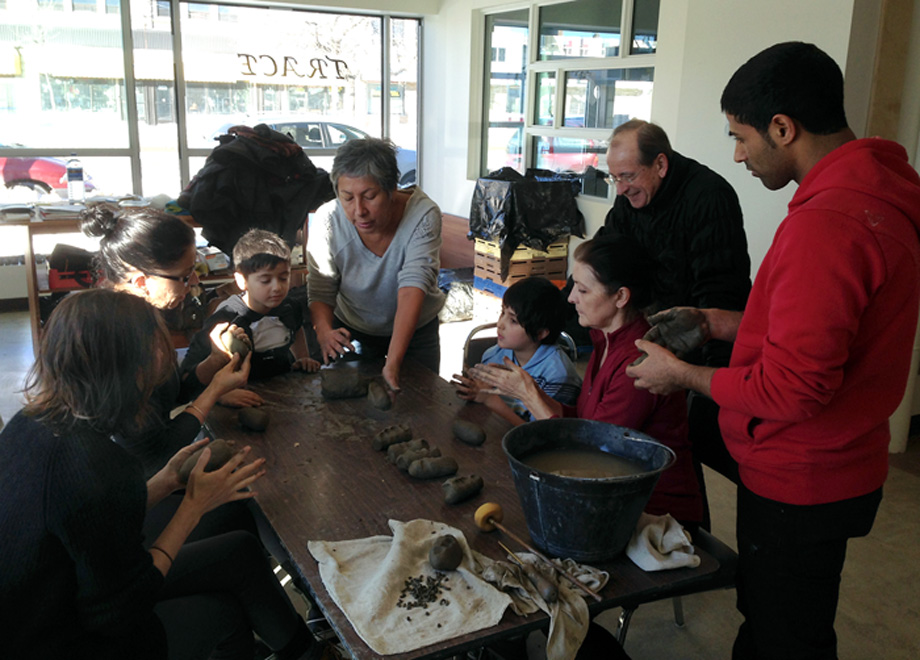
With the creation of the large ceramic blanket, trace, Belmore honours the original inhabitants of the land upon which the Canadian Museum for Human Rights is built. This land bears evidence of over 6,000 years of Indigenous presence where 500,000 artifacts were excavated from the ground beneath the museum, including thousands of ceramic shards. Using clay from beneath the city of Winnipeg, thousands of small “shards” will be formed by hand. The action of squeezing a small lump of clay in one hand will produce an organic shape that will be pierced through the centre to become a “bead”. These shapes, although unique, will identify as being similar due to the hand-made process and because of their vast number. The beads will then be fired and woven together to produce the large-scale blanket-like form. The use of clay, the earth itself, imbues the artwork with a sense of timelessness. The modest gesture of forming these beads is a reminder of how precious and universal the bond is between humans and the earth.
Lee-Ann Martin, Rebecca Belmore’s trace: Hands of generations past and those that will come, 2014
Photo credit: Theo Pelmus
Category: Public Art
Wild Rose
2015 / Wild Rose with Osvaldo Yero / Quarters Armature, Edmonton, AB / Public Art Commission
This stainless steel sculpture is based on two symbols that represent Alberta – the wild rose and the Lodgepole pine. Eighteen feet in height, Wild Rose appears to be an over-sized flower. Up close, the detail of the original materials used to make the sculpture reveal itself. The stem is a weathered Lodgepole pine tree stripped of its branches and bark. On its upper reaches, a piece of cloth, pierced by the pole, billows with the wind, taking on the appearance of an abstract flower. The artists intended Wild Rose to stand as a contemporary and symbolic marker of belonging in a landscape imbued with Indigenous history, and rich with a diversity of natural resources.
Edmonton Arts Council, Wild Rose, City of Edmonton Public Art Collection, website:http://www.arttouryeg.ca/20-rebecca-belmore-osvaldo-yero/, 2015
This stainless steel sculpture is based on two symbols that represent Alberta – the wild rose and the Lodgepole pine. Eighteen feet in height, Wild Rose appears to be an over-sized flower. Up close, the detail of the original materials used to make the sculpture reveal itself. The stem is a weathered Lodgepole pine tree stripped of its branches and bark. On its upper reaches, a piece of cloth, pierced by the pole, billows with the wind, taking on the appearance of an abstract flower. The artists intended Wild Rose to stand as a contemporary and symbolic marker of belonging in a landscape imbued with Indigenous history, and rich with a diversity of natural resources.
Edmonton Arts Council, Wild Rose, City of Edmonton Public Art Collection, website:http://www.arttouryeg.ca/20-rebecca-belmore-osvaldo-yero/, 2015
Upriver
2016 / Upriver with Osvaldo Yero / RIVA, Richmond, BC / Public Art Commission
Two sculptures are contemplatively sited in line with each other and separated by approximately 10 feet in the western-most plaza of the East-West Greenway in the Onni RIVA development. A line drawing made of cedar cut by hand and machine as salmon returns upstream to reach the end of a cycle giving life to a new generation and continual nourishment to all their relations connected to this great river nearby Upriver is a line drawing made into bronze.
Public Art Registry, Upriver, City of Richmond, British Columbia, website:https://www.richmond.ca/culture/publicart/collection/PublicArt.aspx?ID=314, 2016
Photo credit: Courtesy of the artist
Two sculptures are contemplatively sited in line with each other and separated by approximately 10 feet in the western-most plaza of the East-West Greenway in the Onni RIVA development. A line drawing made of cedar cut by hand and machine as salmon returns upstream to reach the end of a cycle giving life to a new generation and continual nourishment to all their relations connected to this great river nearby Upriver is a line drawing made into bronze.
Public Art Registry, Upriver, City of Richmond, British Columbia, website:https://www.richmond.ca/culture/publicart/collection/PublicArt.aspx?ID=314, 2016
Photo credit: Courtesy of the artist
O-ween Du Muh Waun (We Were Told)
2018 / O-ween Du Muh Waun (We Were Told) / Winnipeg, MB/ Public Art Commission
“We chose to install this sculpture here in this place called Winipi Manitowapow, a gathering place for many nations and home to two rivers that meet.The work is a symbol of the failed attempts to assimilate us. We were told to be more like them. It is an “anti-monument” to a forced colonial education. Instead, it speaks to the knowledge that comes from culture, from tradition. The stack of school chairs on a concrete table is deliberately overturned to signify an ending, finality—like the “ivory tower” paradigm of colonial knowledge that Indigenous communities, every day, turns on its head. O-ween du muh waun. The time of being told is over.” -Rebecca Belmore & Osvaldo Yero
Winnipeg Arts Council, O-ween du muh waun, Winnipeg, Canada, 2019
“We chose to install this sculpture here in this place called Winipi Manitowapow, a gathering place for many nations and home to two rivers that meet.The work is a symbol of the failed attempts to assimilate us. We were told to be more like them. It is an “anti-monument” to a forced colonial education. Instead, it speaks to the knowledge that comes from culture, from tradition. The stack of school chairs on a concrete table is deliberately overturned to signify an ending, finality—like the “ivory tower” paradigm of colonial knowledge that Indigenous communities, every day, turns on its head. O-ween du muh waun. The time of being told is over.” -Rebecca Belmore & Osvaldo Yero
Winnipeg Arts Council, O-ween du muh waun, Winnipeg, Canada, 2019