2010 / Ode’min Giizis, Peterborough, ON
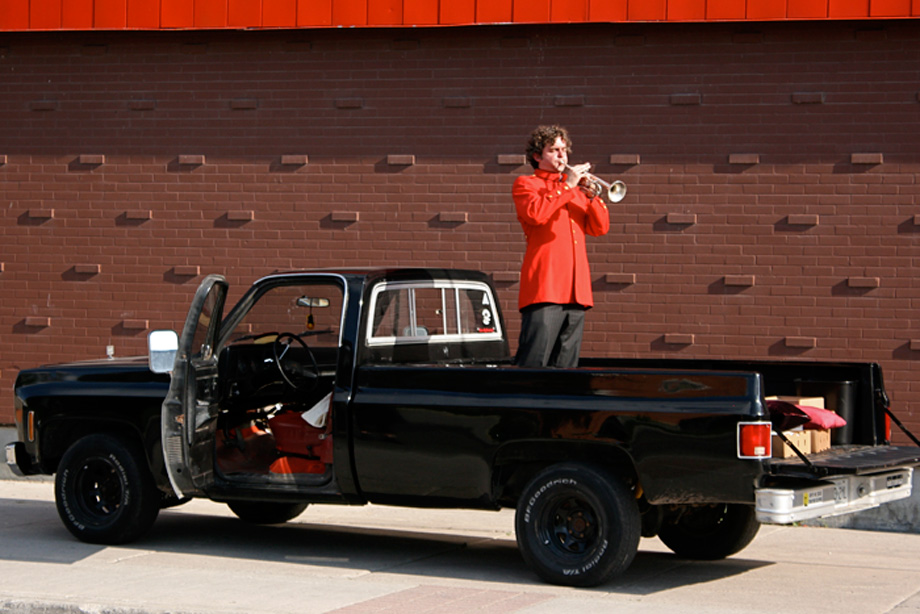
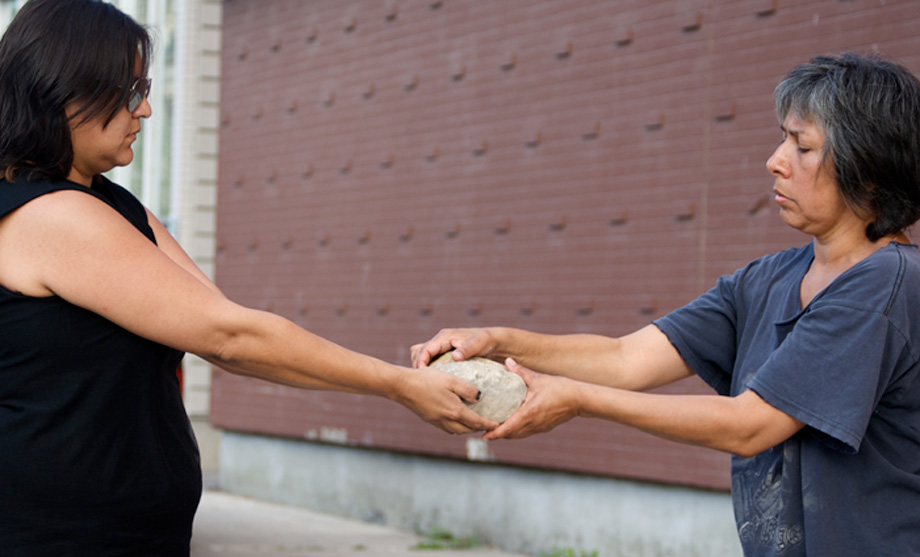
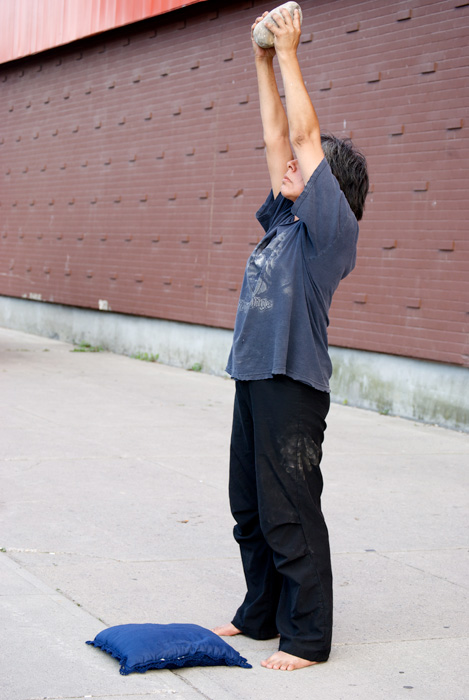
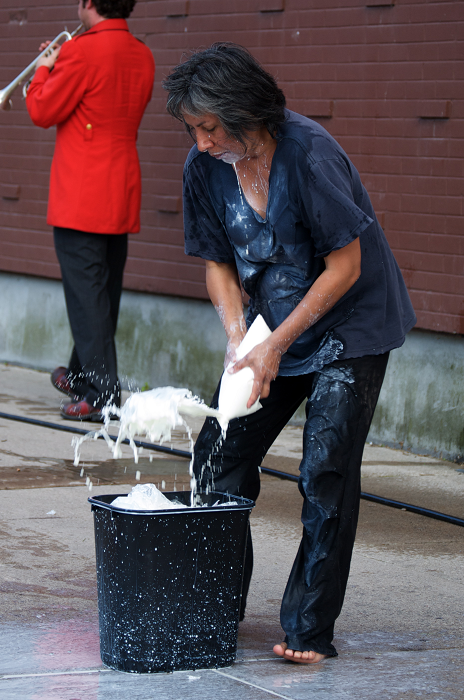
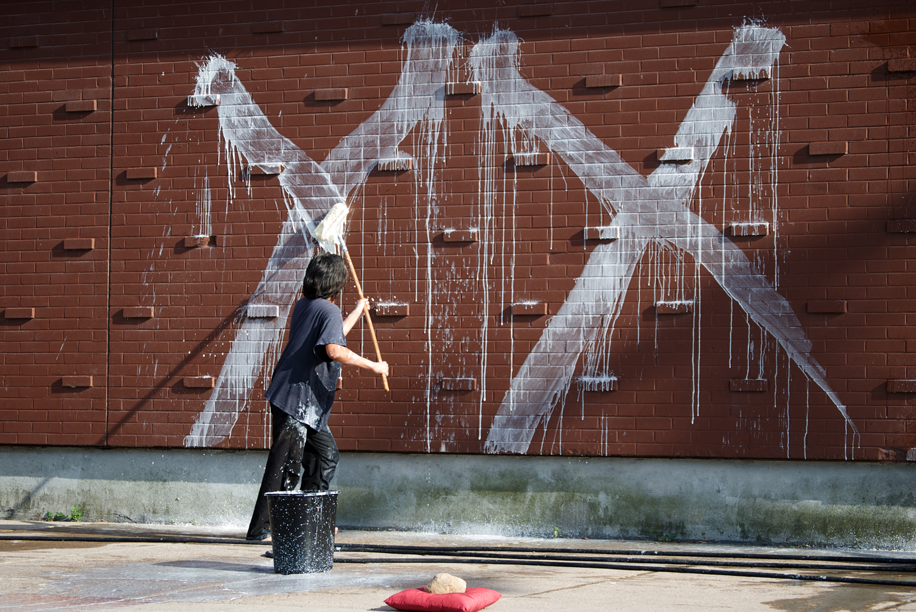
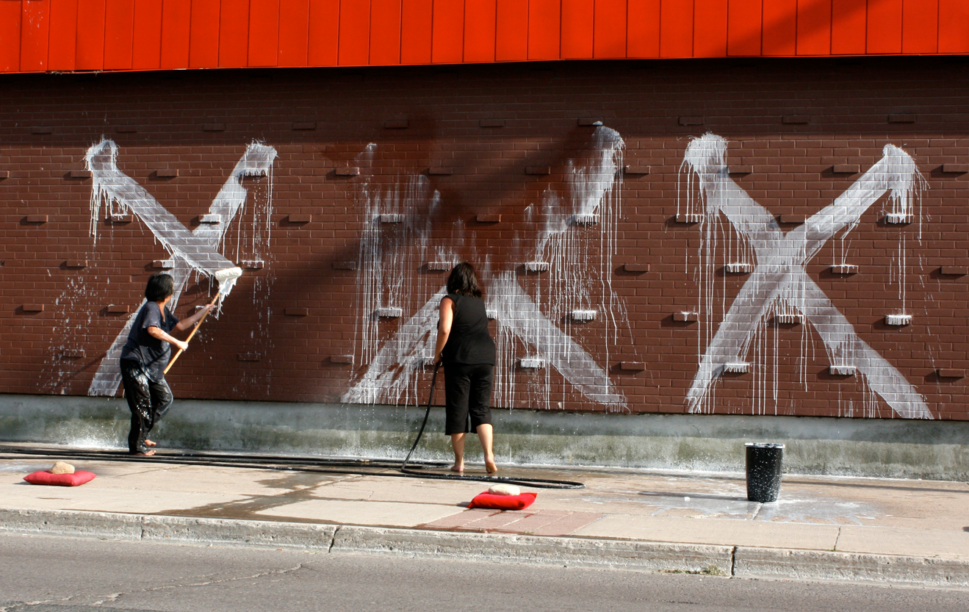
X responds to the Kanehsata:ke resistance of 1990 in the immediate, and the present space of a Price Chopper grocery store in Peterborough, ON. Curve Lake First Nation are having a ceremony across the street to rebury the body of a 2,000-year-old Indigenous man uncovered when the parking lot was created. The artist and the assistant perform repetitive actions of marking, erasing, marking, and erasing large Xs on the grocery store wall while, across the street, a ritual of return, a reburial of what was disturbed and removed, is taking place.
Wanda Nanibush, ed., Facing the Monumental: Rebecca Belmore, Art Gallery of Ontario, 2018
Photo credit: Elizabeth Thipphawong / Ode’min Giizis Festival
Category: Performances
Facing the Monumental
2012 / House of Wayward Spirits, Queen’s Park, Toronto, ON
A 150-year-old indigenous red oak tree, a living witness to colonization, is wrapped in kraft paper. The artist places a woman into the installation and wraps her and the tree together. The tree becomes a temporary monument to the earth, to women, to life.
Wanda Nanibush, ed., Facing the Monumental: Rebecca Belmore, Art Gallery of Ontario, Toronto, 2018
Video credit: Alex Williams
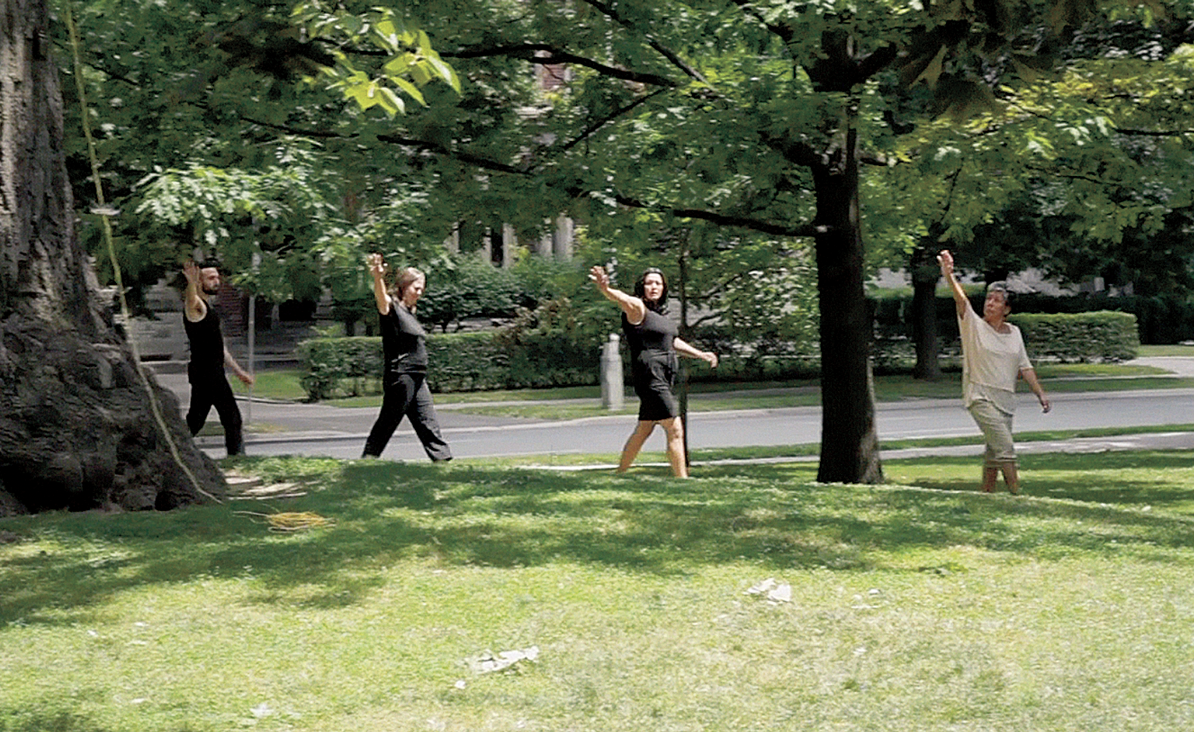
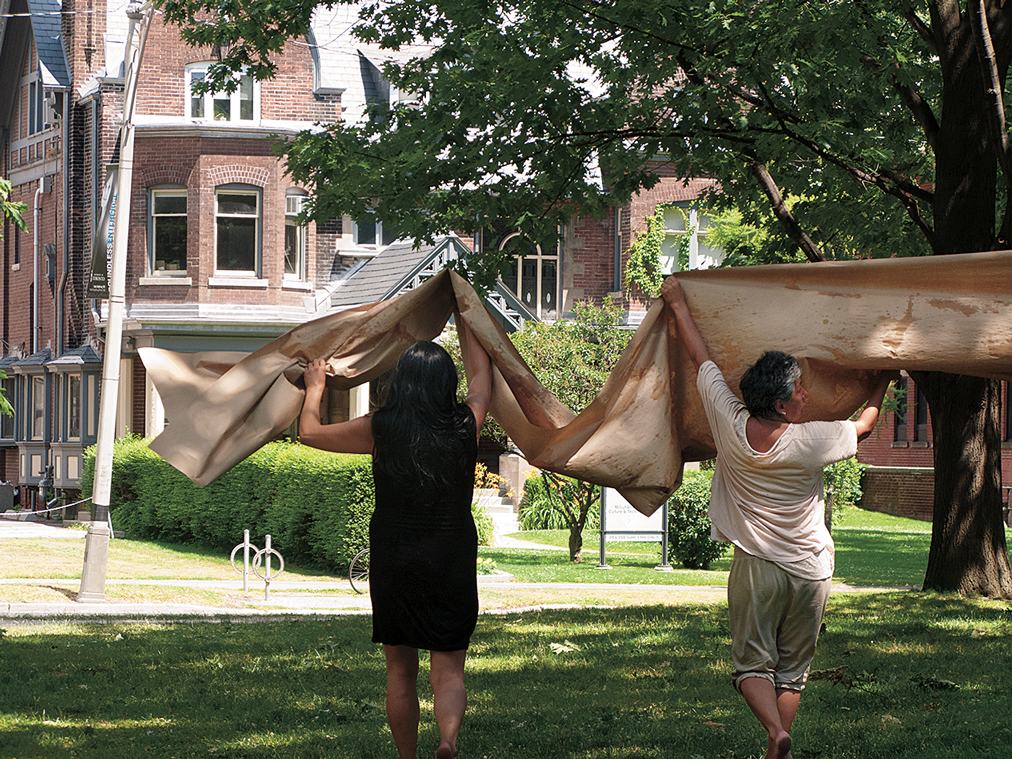
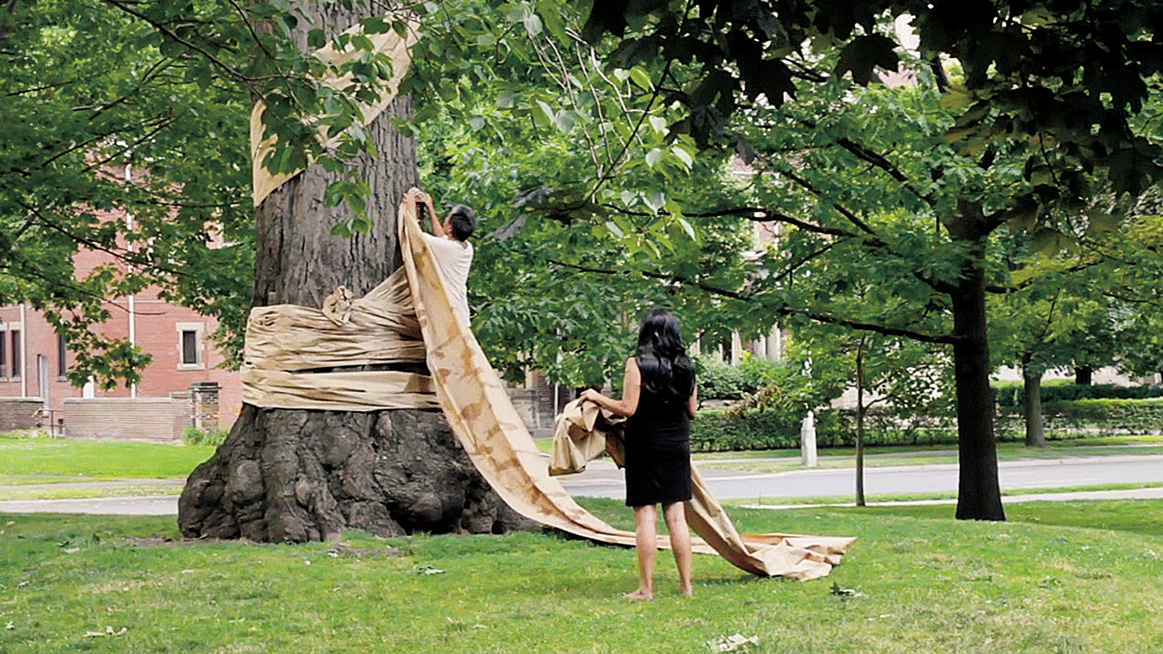
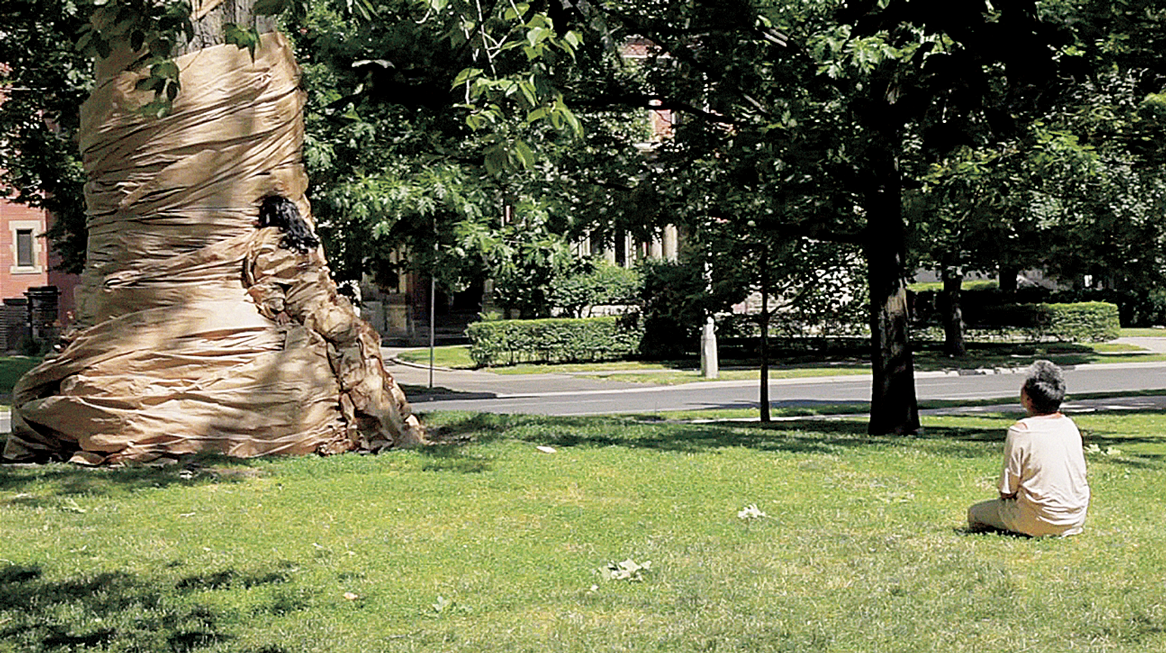
A 150-year-old indigenous red oak tree, a living witness to colonization, is wrapped in kraft paper. The artist places a woman into the installation and wraps her and the tree together. The tree becomes a temporary monument to the earth, to women, to life.
Wanda Nanibush, ed., Facing the Monumental: Rebecca Belmore, Art Gallery of Ontario, Toronto, 2018
Video credit: Alex Williams
Theatre of the Brave
2015 / Acting O U T: Performances by James Luna, Guillermo Gómez-Peña and Rebecca Belmore,
IAIA Museum of Contemporary Native Arts, Santa Fe, NM
Belmore’s response to the traditional theater space was a remarkable performance entitled the Theatre of the Brave, in which she projected her face, covered in a paper mask of an Indian man in a feathered headdress, onto an enormous screen. Her voice pitched a few octaves lower, she called out to the land and her people: “It belongs to us, and that is our story! I have spoken.” Filling the silent auditorium with her incantation, she frequently interrupted her narrative to shout out “Brother!,” at which point a musician onstage would let forth a mournful melody on his distorted slide guitar. Her quasi-comedic evocation of displacement was beautiful and deeply unsettling.
Lucas Iberico Lozada, North America’s Most Important Indigenous Performance Artists Convene in Santa Fe, Artsy, 2015
Photo credit: Jason S. Ordaz / Institute of American Indian Arts
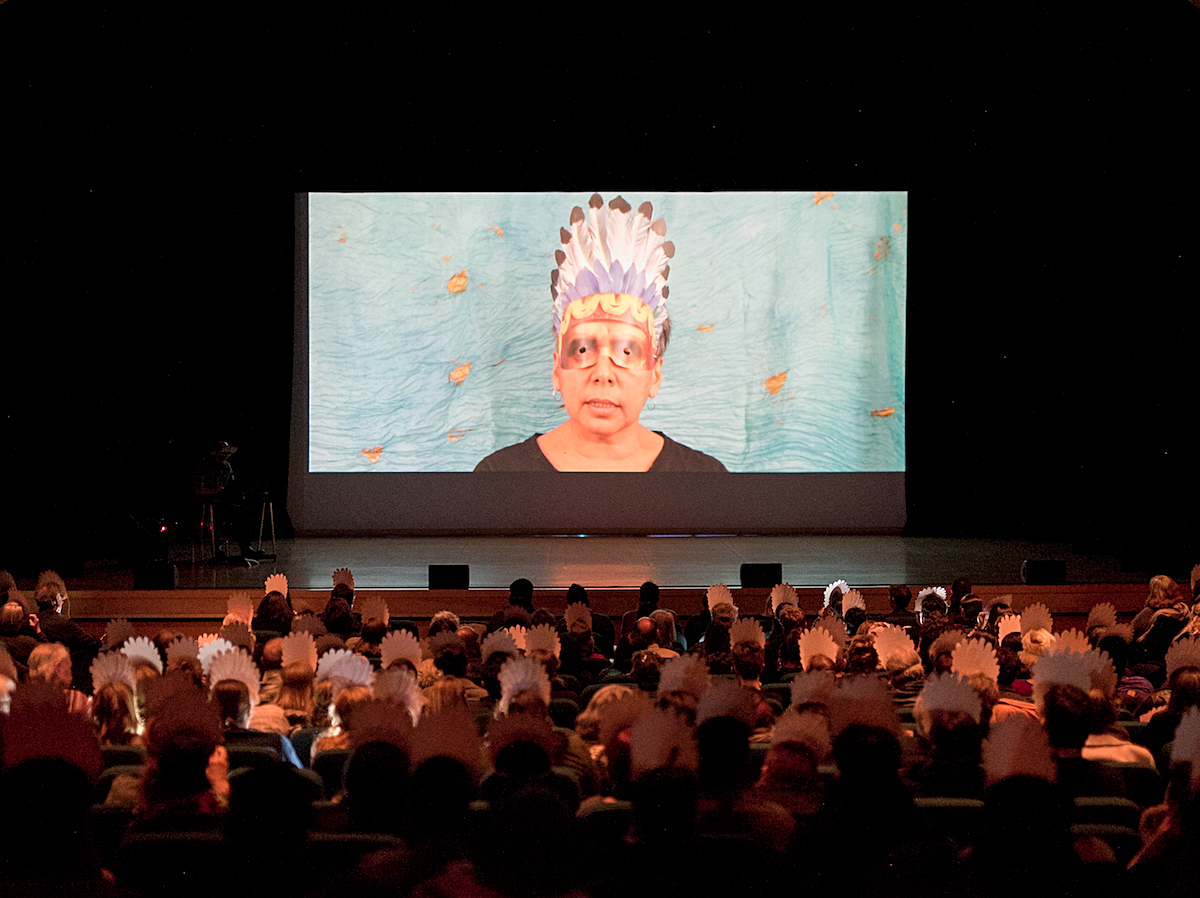
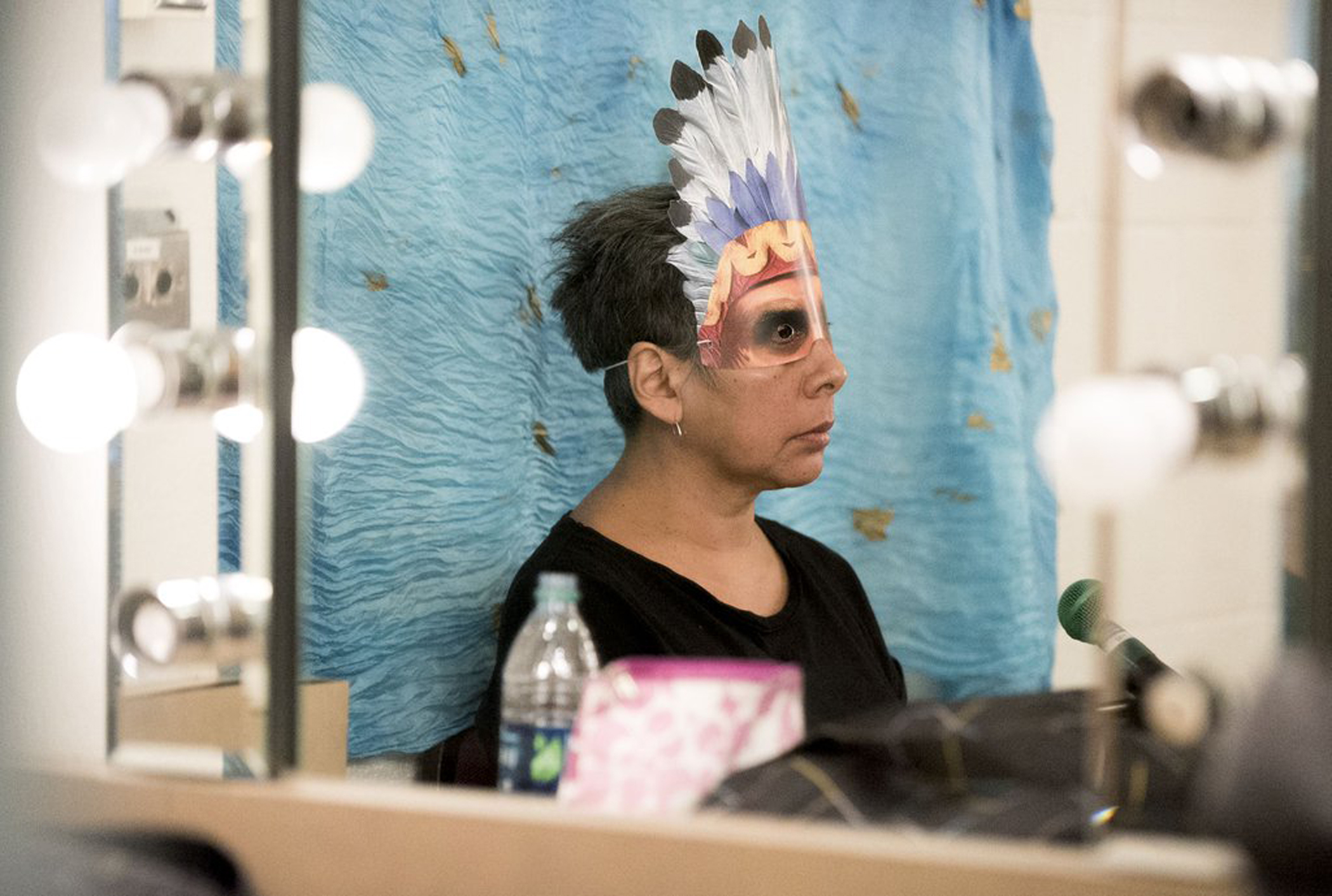
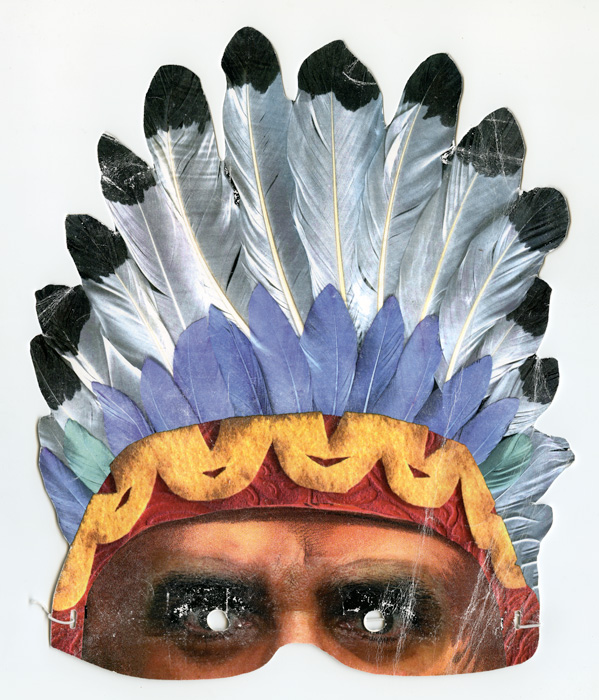
Belmore’s response to the traditional theater space was a remarkable performance entitled the Theatre of the Brave, in which she projected her face, covered in a paper mask of an Indian man in a feathered headdress, onto an enormous screen. Her voice pitched a few octaves lower, she called out to the land and her people: “It belongs to us, and that is our story! I have spoken.” Filling the silent auditorium with her incantation, she frequently interrupted her narrative to shout out “Brother!,” at which point a musician onstage would let forth a mournful melody on his distorted slide guitar. Her quasi-comedic evocation of displacement was beautiful and deeply unsettling.
Lucas Iberico Lozada, North America’s Most Important Indigenous Performance Artists Convene in Santa Fe, Artsy, 2015
Photo credit: Jason S. Ordaz / Institute of American Indian Arts
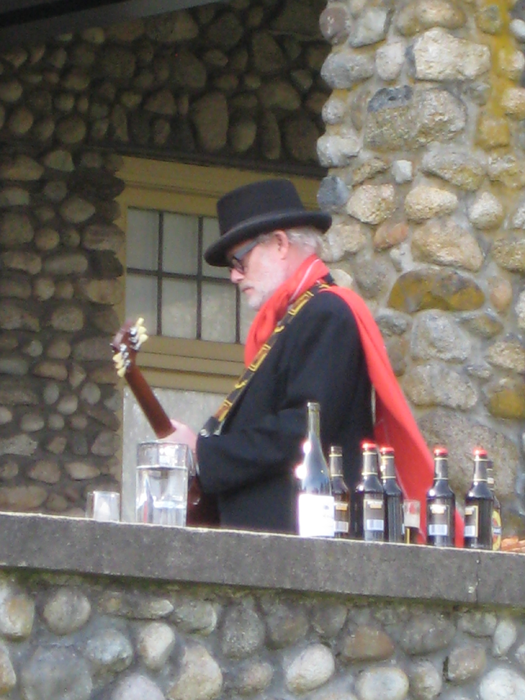
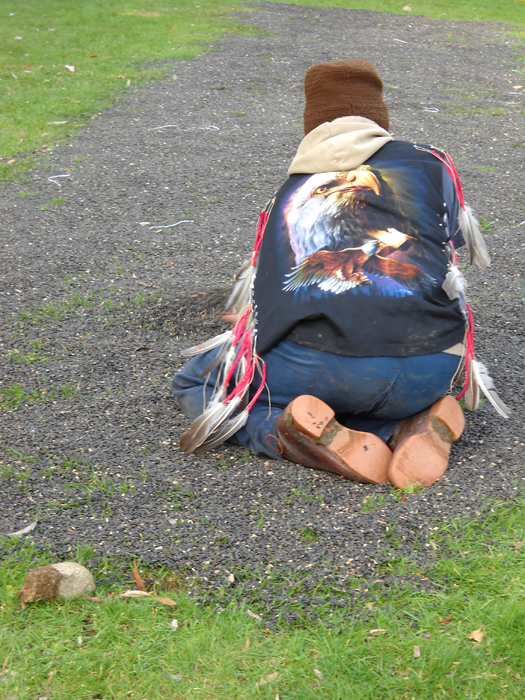
Feast at Fairacres

Vigil
2002 / Talking Stick Festival, Full Circle: First Nations Performance, Vancouver, BC
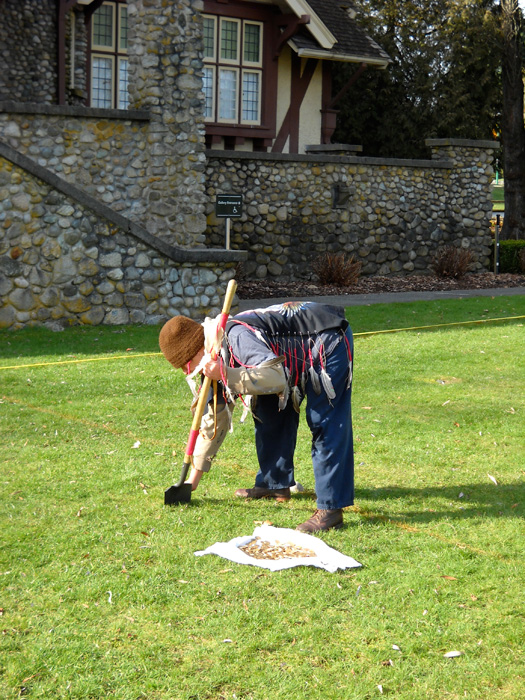
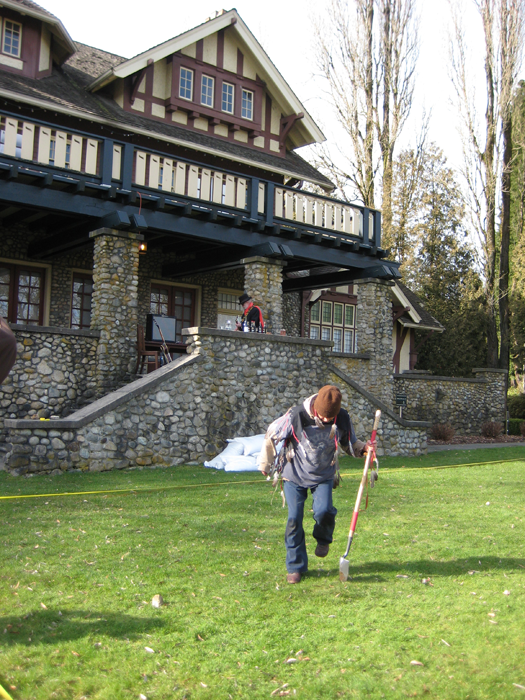
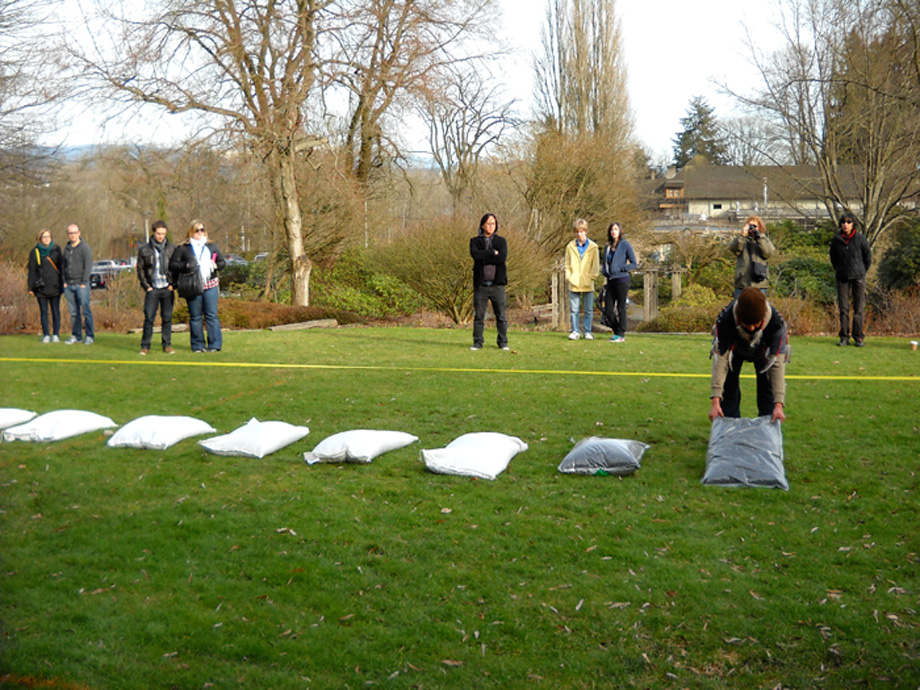
Vigil, a performance at the corner of Gore and Cordova Streets on June 23, 2002, two of the tawdry streets that are common sites of abduction. The performance included all the elements of a classic ritual: establishing a bounded, liminal space, cleansing—a purification which puts the protagonist in a vulnerable or dangerous position, their body marked out in some way or identified by special clothing—endurance, repetitive action, release; a closing sequence with the returning to the ‘real’ world. In Vigil the women’s first names are written in black marker all over her arms as cues, prompting Belmore to yell them out at the top of her voice, and after each name to draw a rose, with its thorns, through her closed lips.
In the performance, crimes against the body, the native body, the woman’s body, are embodied in, enacted by, or inscribed on her own body, as if in an act of atonement. The names also draw attention to the fact that the kin-based, named, relationships of native communities were overlaid, where they were not replaced by the property relations of capitalism. Place names, plant names, people’s names—all overlaid, all changed. In closing, Belmore, now in jeans and t-shirt, leans up against a looming black pick-up truck, with all the male signifying options, that has been there all the time, parked at the periphery of her action. James Brown’s It’s a Man’s Man’s [Man’s] World booms magnificently out from the truck’s stereo:
“This is a man’s man’s [man’s] world / but it wouldn’t mean nothing, nothing / without a woman or a girl.”
Charlotte Townsend-Gault, Have We Ever Been Good?, The Named and the Unnamed, Morris and Helen Belkin Art Gallery, University of British Columbia, 2002
Video credit: Paul Wong
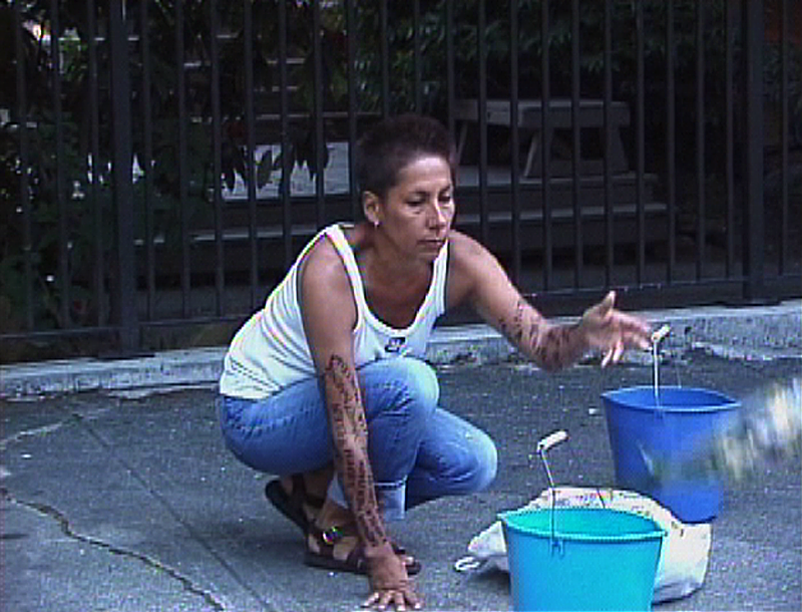
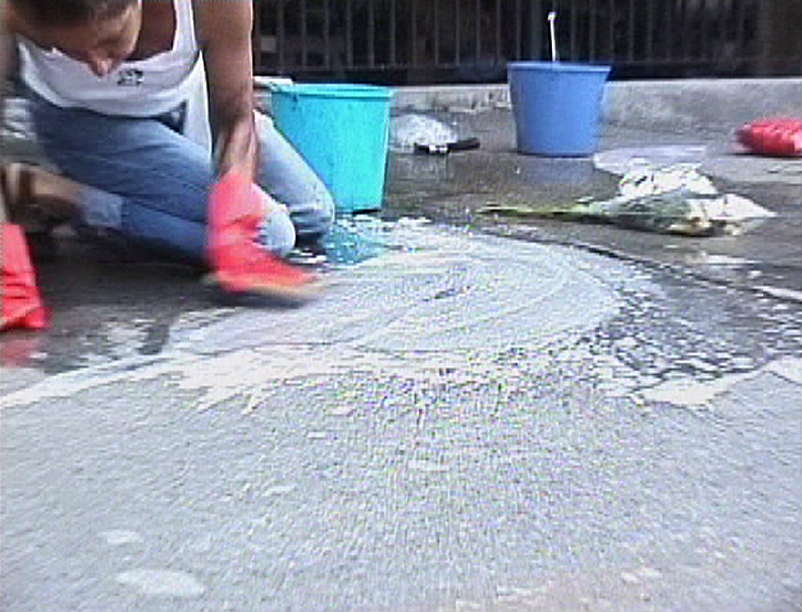
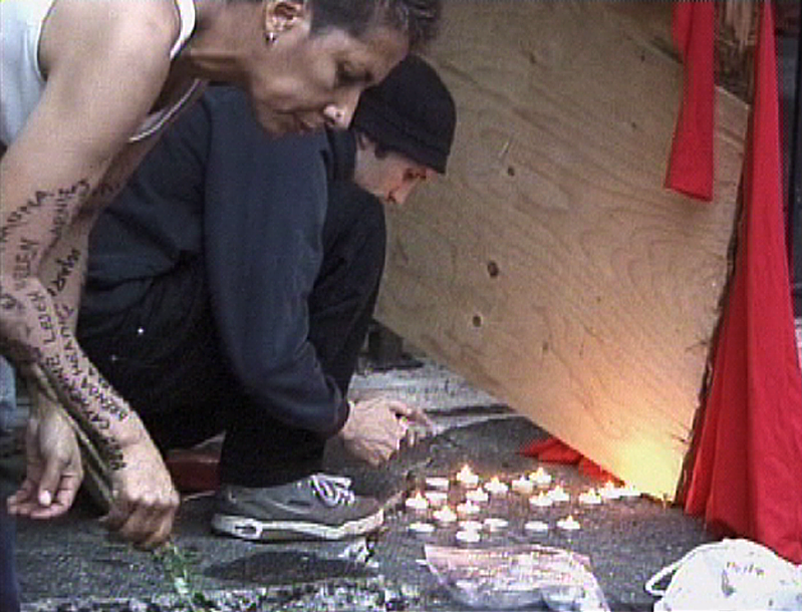

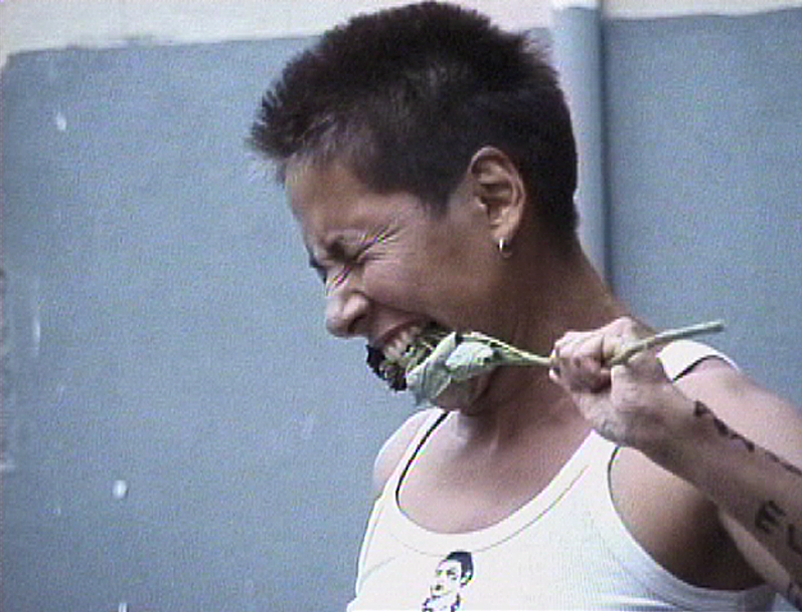
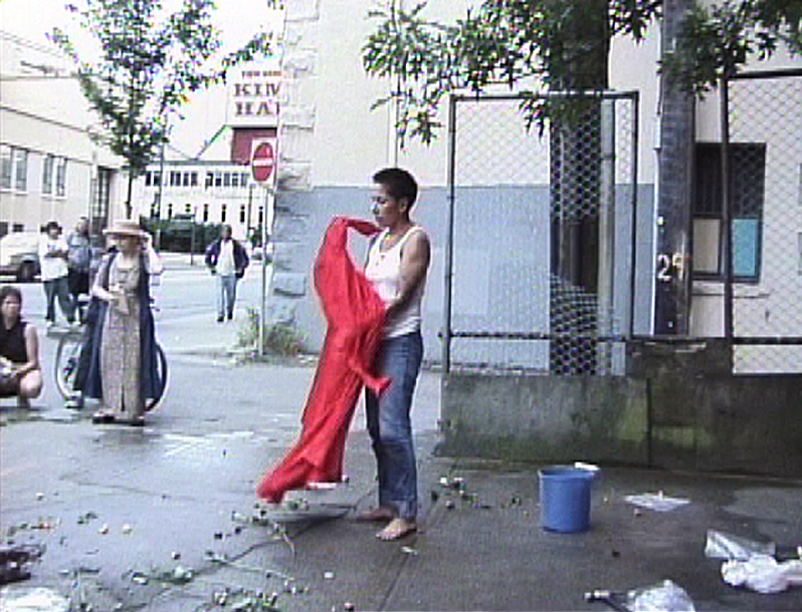
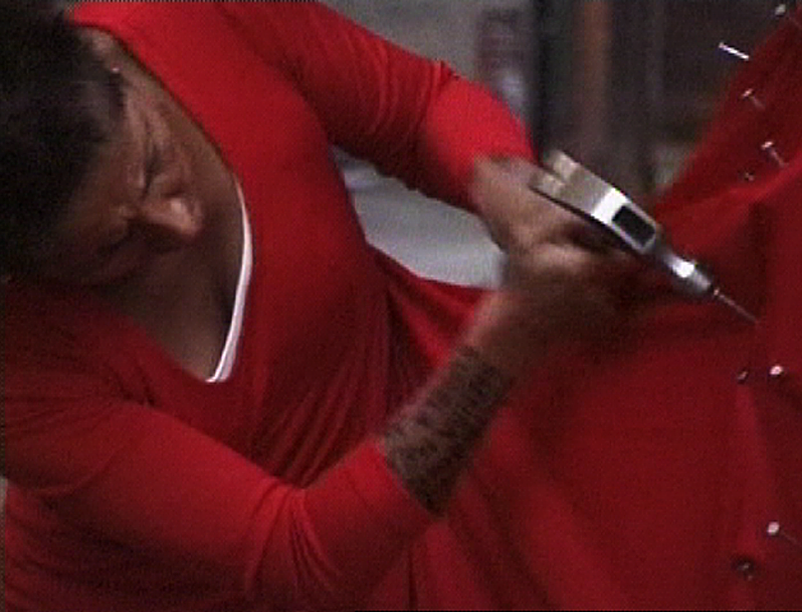

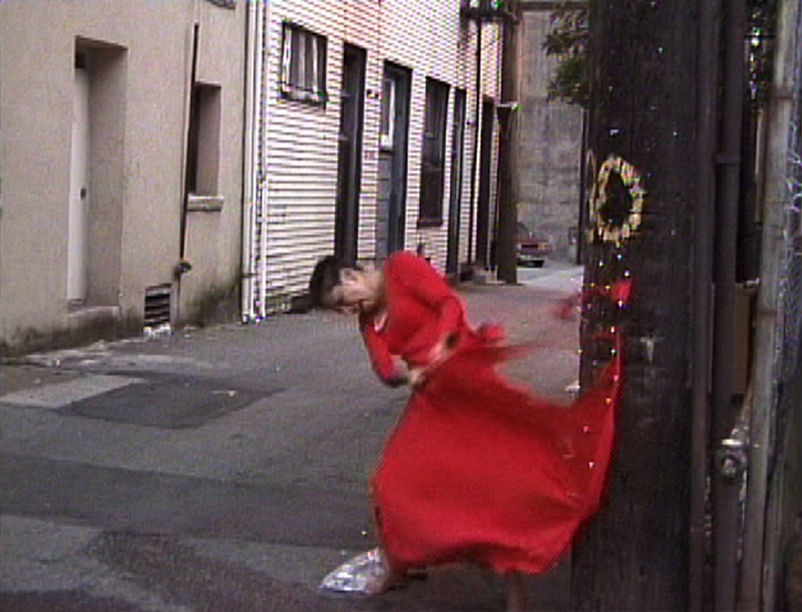
Vigil, a performance at the corner of Gore and Cordova Streets on June 23, 2002, two of the tawdry streets that are common sites of abduction. The performance included all the elements of a classic ritual: establishing a bounded, liminal space, cleansing—a purification which puts the protagonist in a vulnerable or dangerous position, their body marked out in some way or identified by special clothing—endurance, repetitive action, release; a closing sequence with the returning to the ‘real’ world. In Vigil the women’s first names are written in black marker all over her arms as cues, prompting Belmore to yell them out at the top of her voice, and after each name to draw a rose, with its thorns, through her closed lips.
In the performance, crimes against the body, the native body, the woman’s body, are embodied in, enacted by, or inscribed on her own body, as if in an act of atonement. The names also draw attention to the fact that the kin-based, named, relationships of native communities were overlaid, where they were not replaced by the property relations of capitalism. Place names, plant names, people’s names—all overlaid, all changed. In closing, Belmore, now in jeans and t-shirt, leans up against a looming black pick-up truck, with all the male signifying options, that has been there all the time, parked at the periphery of her action. James Brown’s It’s a Man’s Man’s [Man’s] World booms magnificently out from the truck’s stereo:
“This is a man’s man’s [man’s] world / but it wouldn’t mean nothing, nothing / without a woman or a girl.”
Charlotte Townsend-Gault, Have We Ever Been Good?, The Named and the Unnamed, Morris and Helen Belkin Art Gallery, University of British Columbia, 2002
Video credit: Paul Wong
A Simple Truth
2003 / LIVE Biennial of Performance Art Festival, Western Front, Vancouver, BC
A Simple Truth is a performance in which Belmore discusses her process of creating work through a narrative involving her connection to the suicide of a student with whom she worked with during a residency. During the performance, she lies down while being surrounded by glasses with candles lit inside that are carried out of the Western Front when the performance ends.
Western Front, 2003
Photo credit: Valorie Pudsey / Western Front
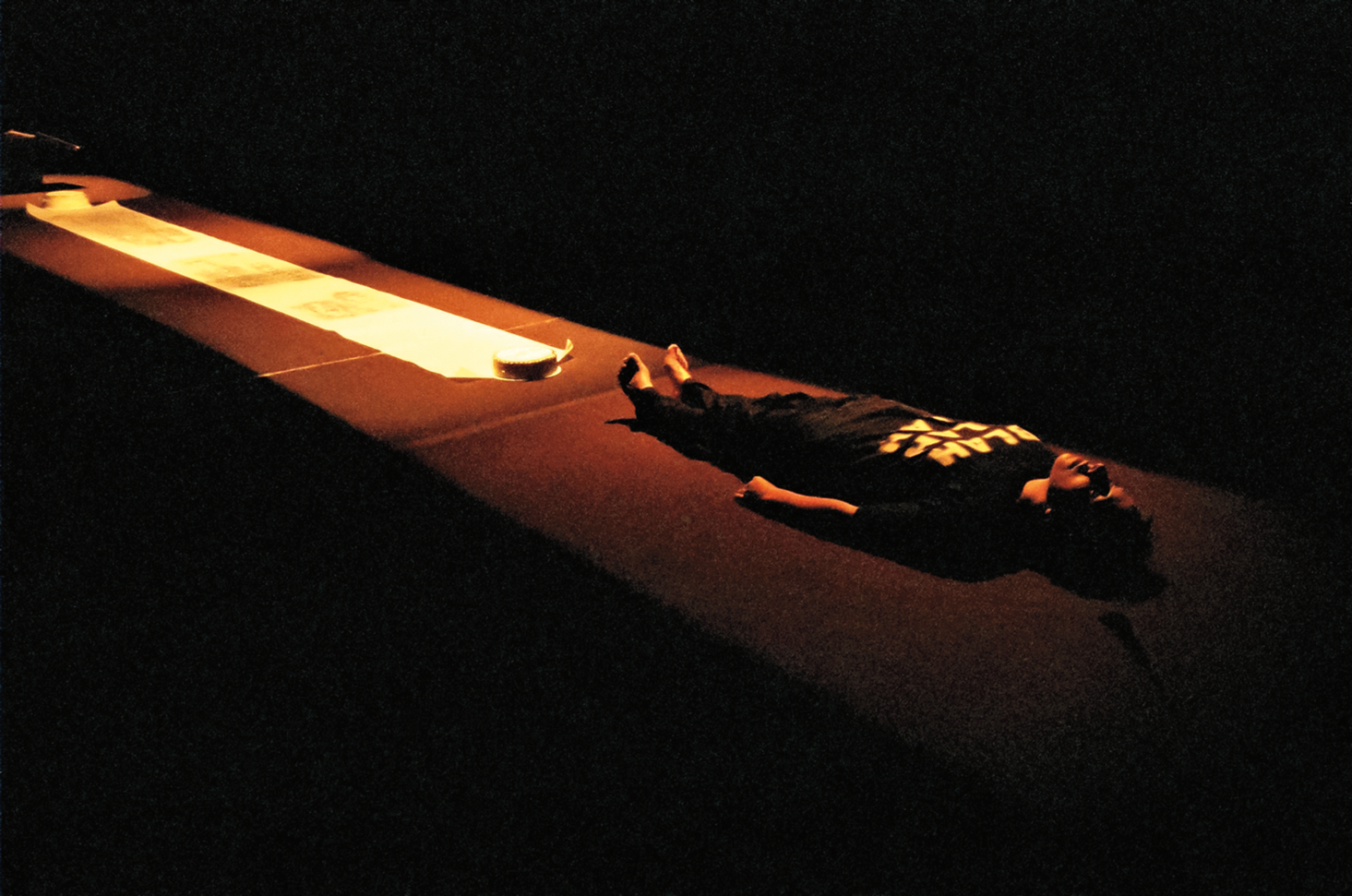
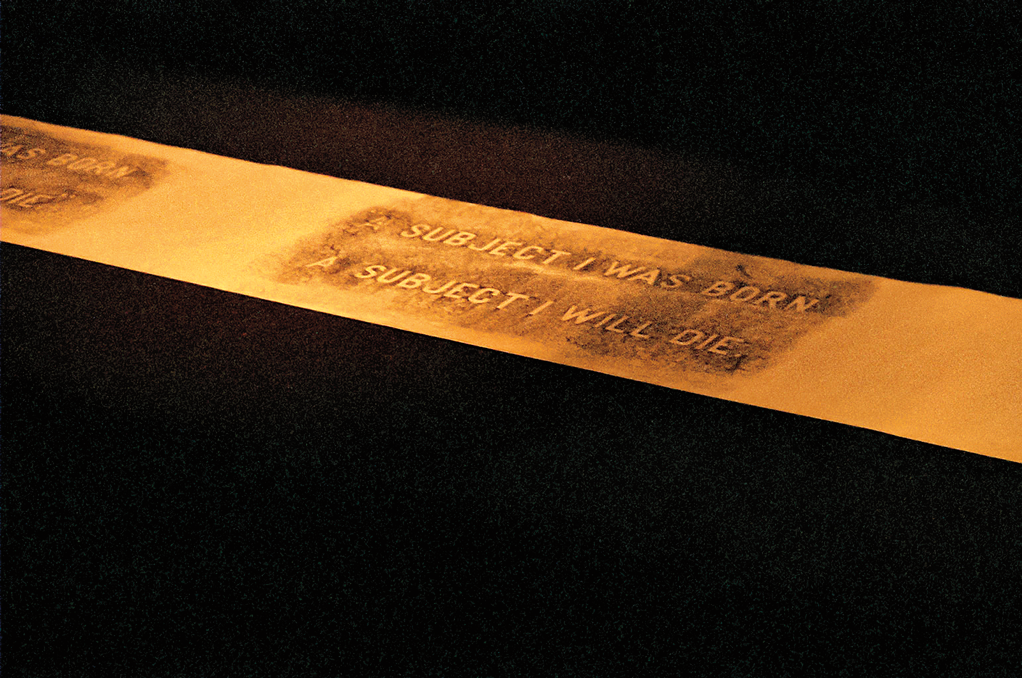
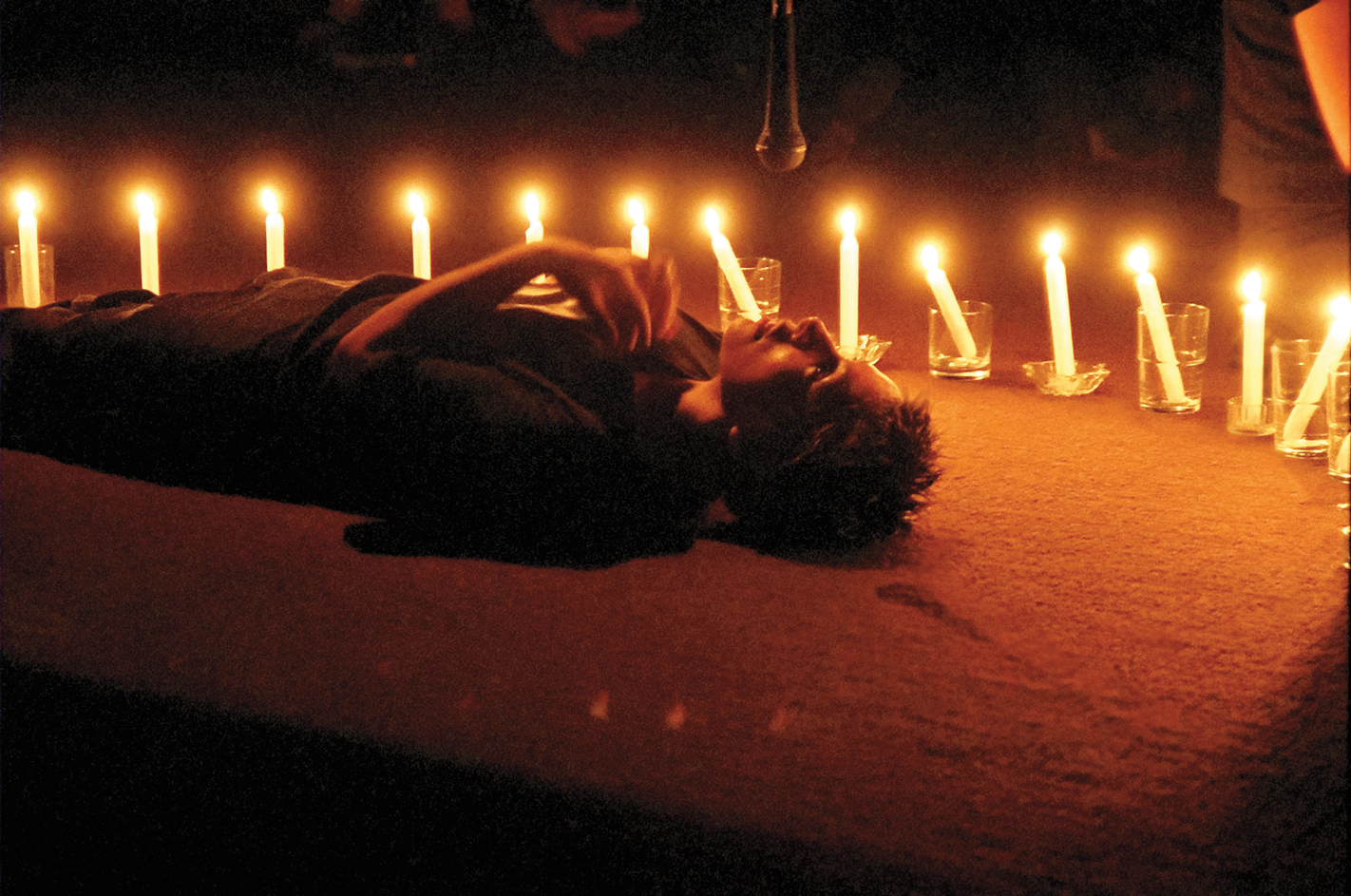
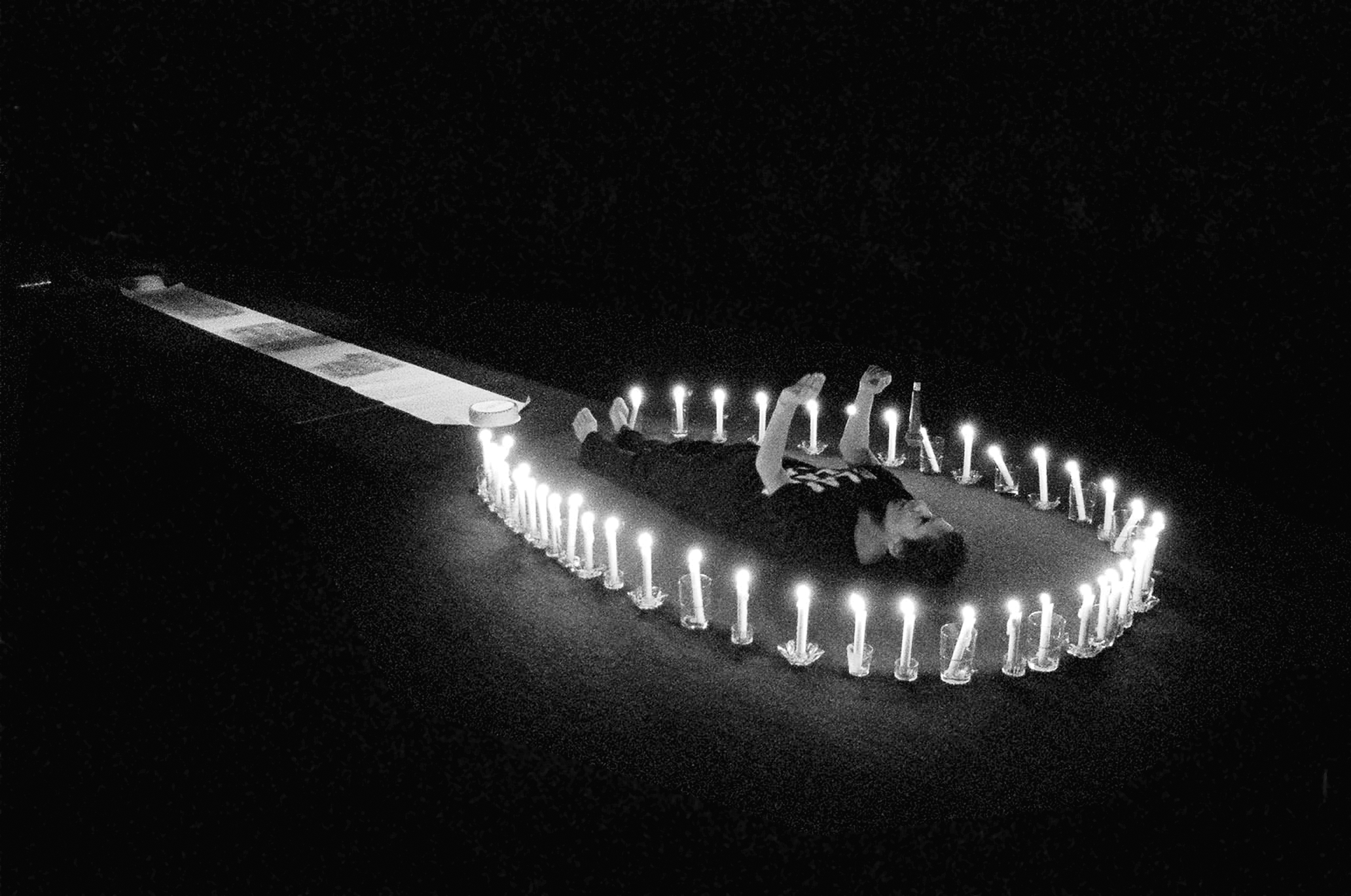
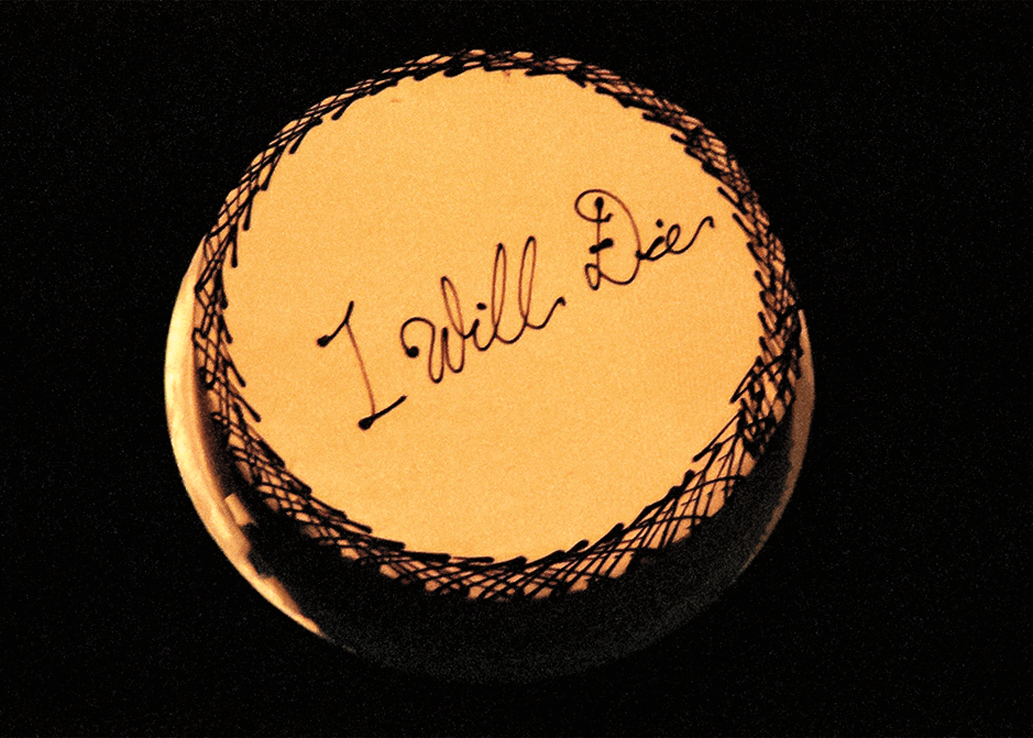
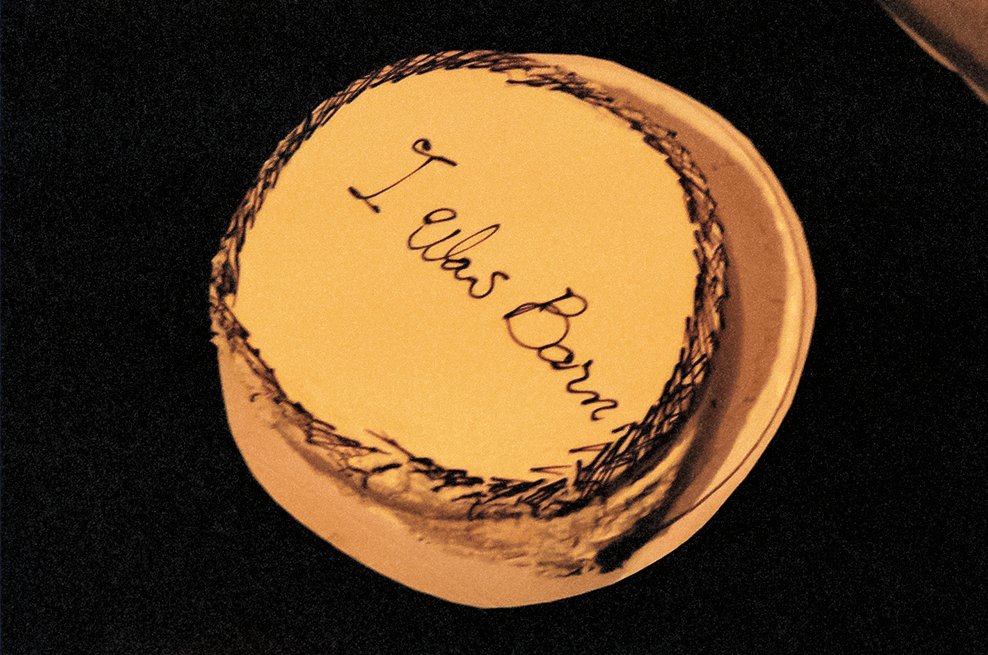
A Simple Truth is a performance in which Belmore discusses her process of creating work through a narrative involving her connection to the suicide of a student with whom she worked with during a residency. During the performance, she lies down while being surrounded by glasses with candles lit inside that are carried out of the Western Front when the performance ends.
Western Front, 2003
Photo credit: Valorie Pudsey / Western Front
Bury My Heart
2000 / Paris Gibson Square Museum, Great Falls, Montana
A performance based on history. In the winter of 1890, three hundred Oglala Sioux, most of them women and children, were massacred by the US Cavalry at Wounded Knee Creek, South Dakota. Their bodies were left exposed.
Video credit: Paris Gibson Square Museum

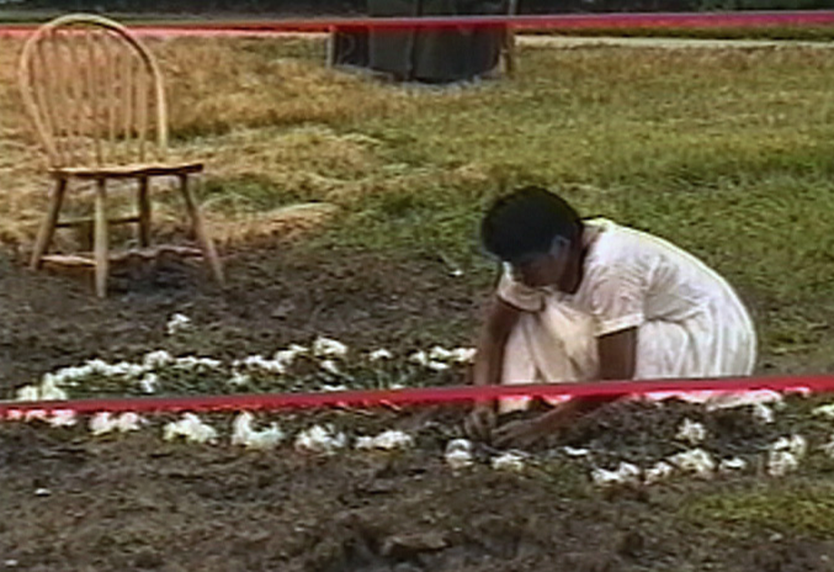
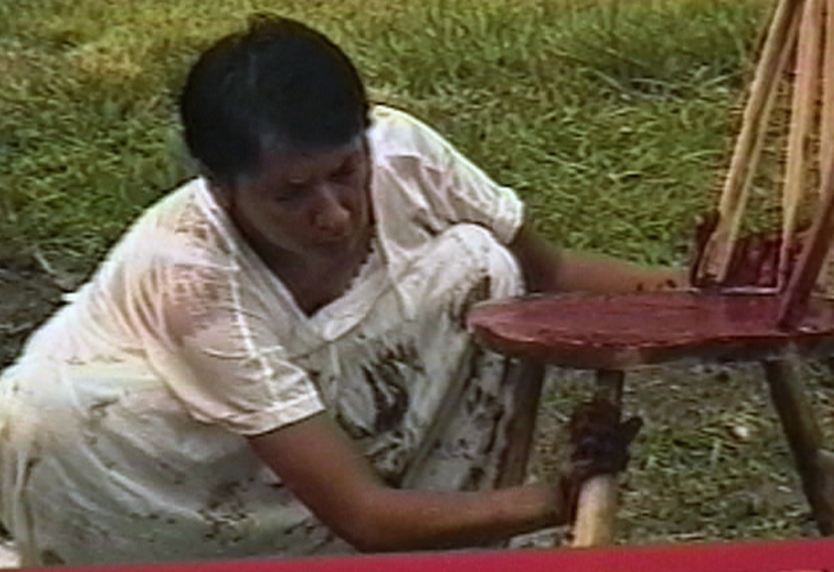
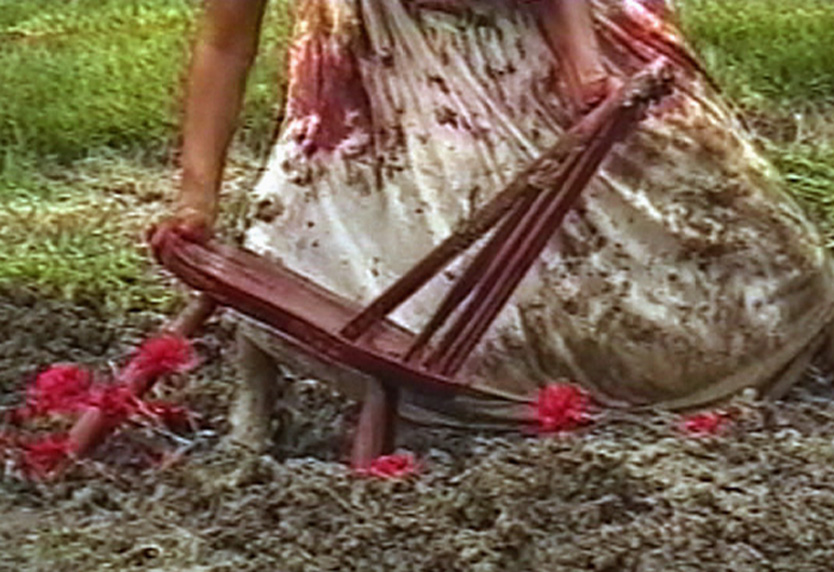
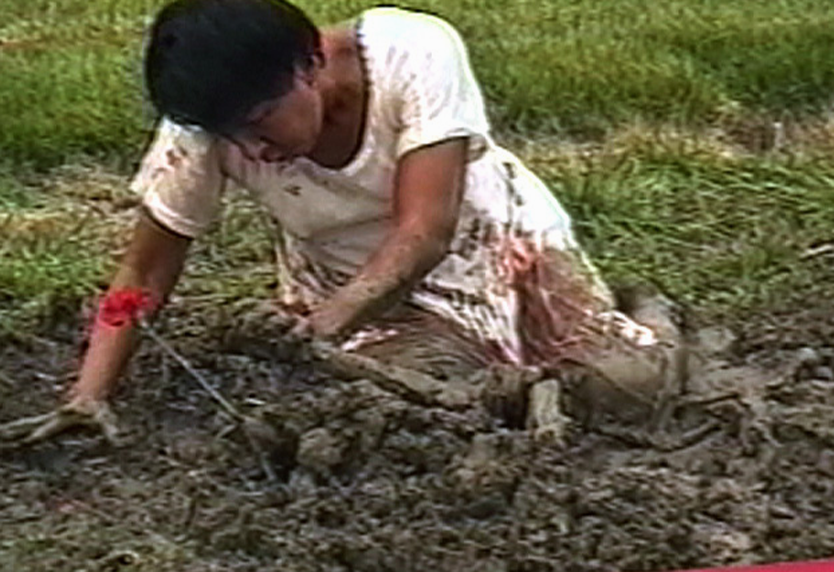
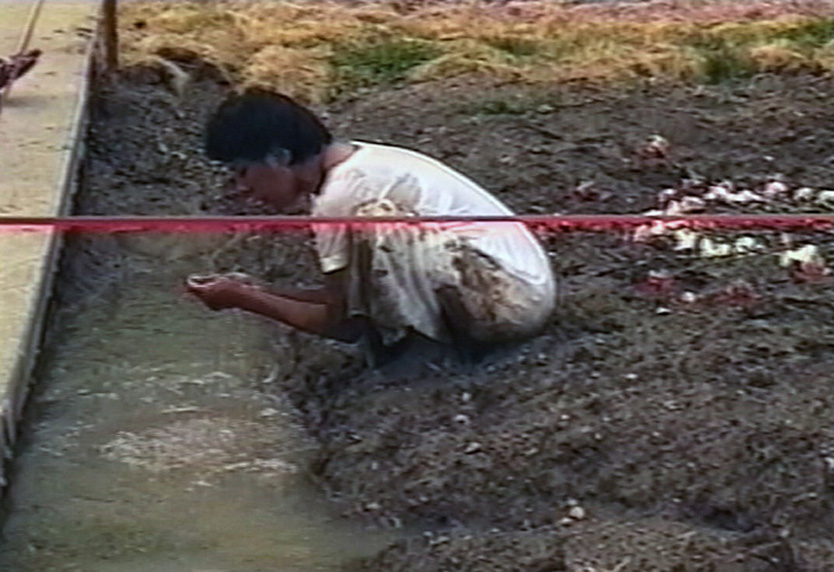
A performance based on history. In the winter of 1890, three hundred Oglala Sioux, most of them women and children, were massacred by the US Cavalry at Wounded Knee Creek, South Dakota. Their bodies were left exposed.
Video credit: Paris Gibson Square Museum
Back to the Garden
2006 / Urban Shaman and aceart inc., Winnipeg, MB
Three vehicles. Three copies of the orchestrated version of singer Joni Mitchell’s “Woodstock”. Eight volunteers dressed in white, two cellists (Jonathan Bauch and Blair Burns) dressed in black. 150 red roses attached with paper tags. Two long poles strung with netting laid flat in an empty parking lot border by one wall. The performer wears a black dress.
Performer arrives, holding roses onto which individual audience members have written the first name of a woman who is close to them. The headlights of two vehicles light the wall. Four male volunteers get out of the vehicles and work with the performer to attach the roses to the net. Chairs and music stands are set in place. Cellists begin to play “Woodstock” as two volunteers raise the poles strung with roses in the headlights in front of the wall. Performer paces the parking lot. Removes the black dress. The nude performer begins to strike numerous poses mimicking images from art and death. Performer dresses. Cellists finish. Volunteers strike the set. Drivers start their engines and depart with “Woodstock” playing on the vehicle stereos.
Video credit: Darryl Nepinak
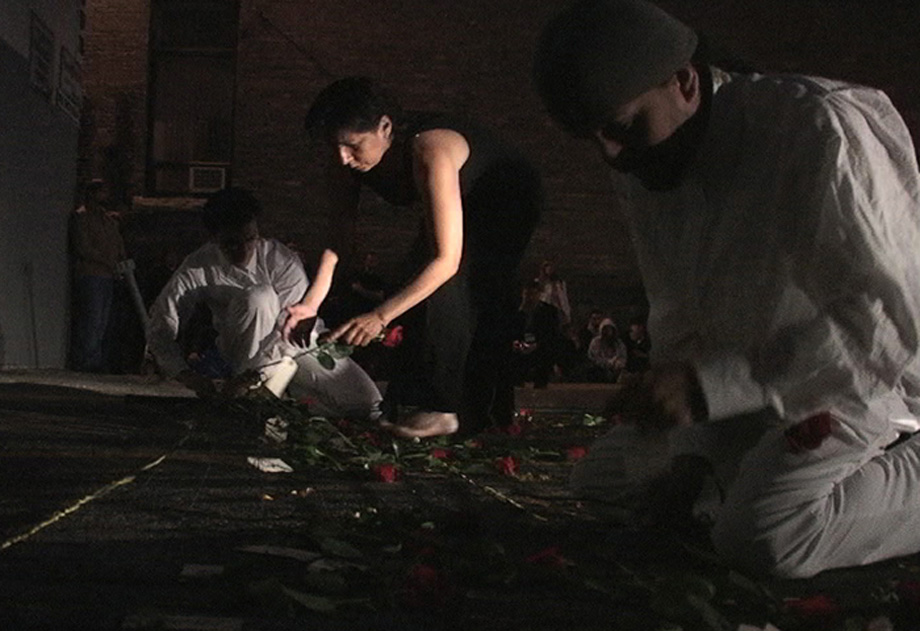
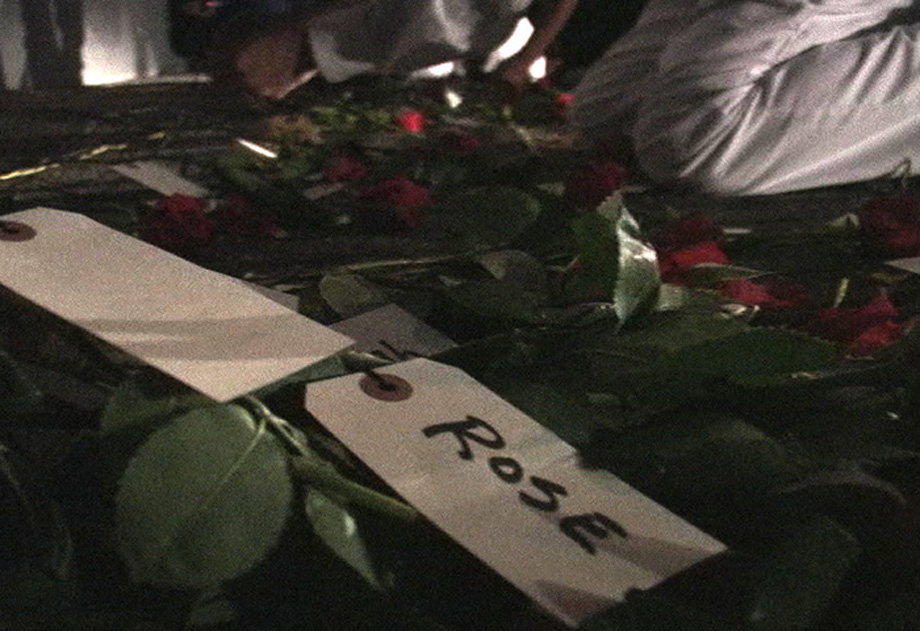
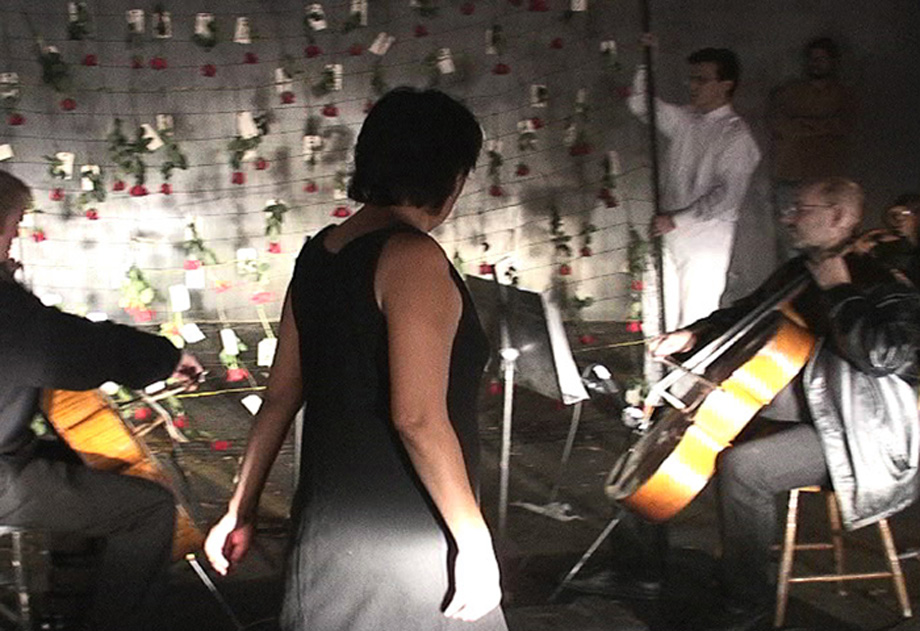
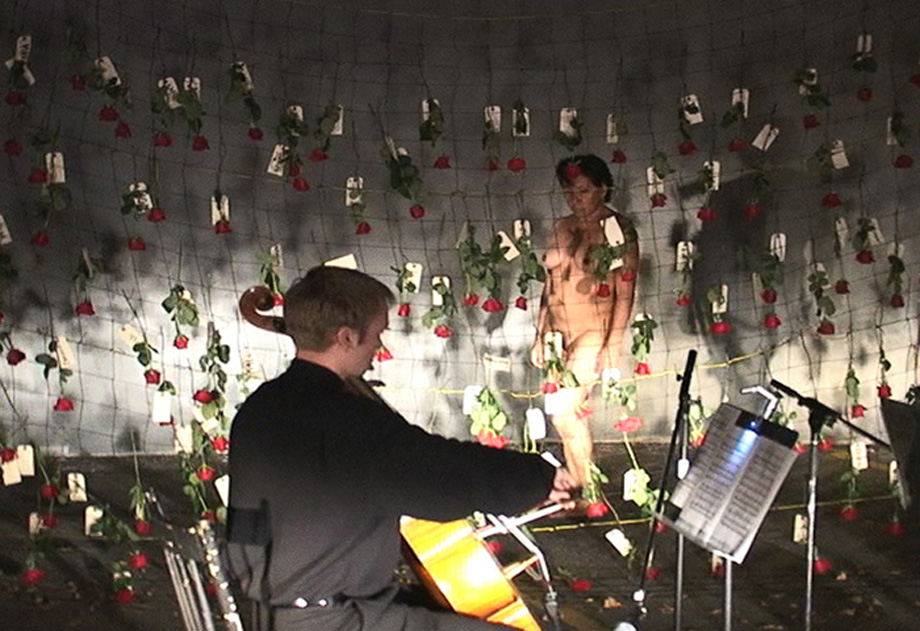
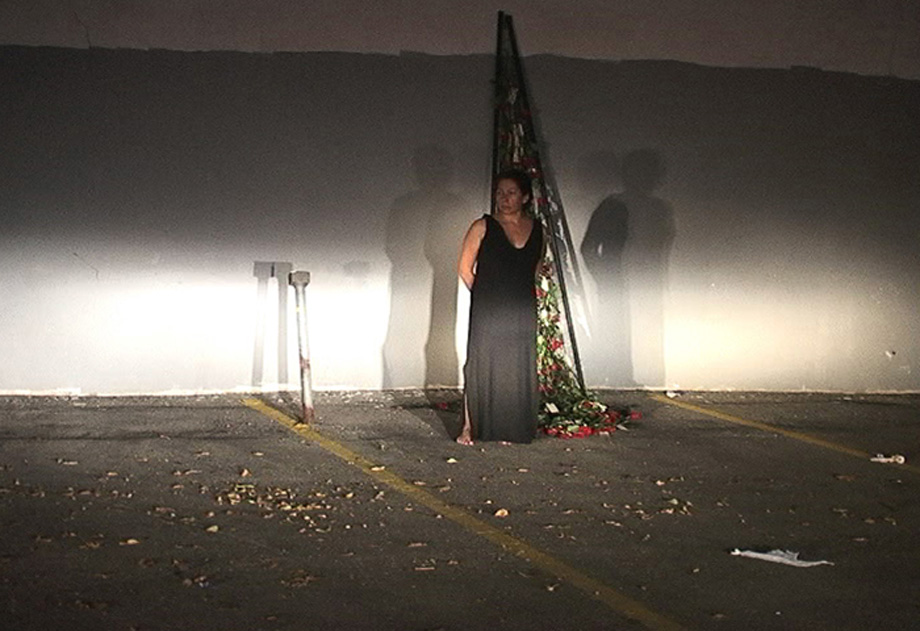
Three vehicles. Three copies of the orchestrated version of singer Joni Mitchell’s “Woodstock”. Eight volunteers dressed in white, two cellists (Jonathan Bauch and Blair Burns) dressed in black. 150 red roses attached with paper tags. Two long poles strung with netting laid flat in an empty parking lot border by one wall. The performer wears a black dress.
Performer arrives, holding roses onto which individual audience members have written the first name of a woman who is close to them. The headlights of two vehicles light the wall. Four male volunteers get out of the vehicles and work with the performer to attach the roses to the net. Chairs and music stands are set in place. Cellists begin to play “Woodstock” as two volunteers raise the poles strung with roses in the headlights in front of the wall. Performer paces the parking lot. Removes the black dress. The nude performer begins to strike numerous poses mimicking images from art and death. Performer dresses. Cellists finish. Volunteers strike the set. Drivers start their engines and depart with “Woodstock” playing on the vehicle stereos.
Video credit: Darryl Nepinak
Anthem
Creation or Death: We Will Win
1991 / IV Bienal de la Habana, Castillo de la Fuerza, Havana
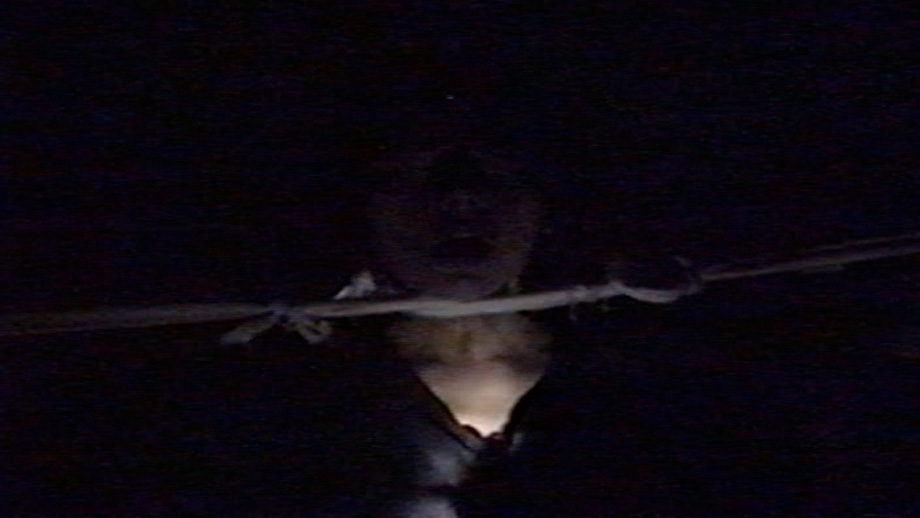
Belmore moved a pile of dirt up a long staircase, stair by stair, in a state of desperate frenzy. Dirt is lost at every stage and it is not at all certain that any of it will make it to the landing at the top of the stairs. The title of the piece reveals its intention to have the viewer experience the piece as the struggle of Indigenous people to reclaim their territories and culture.
Jolene Rickard, Rebecca Belmore: Performing Power, Fountain, Kamloops Art Gallery and Morris and Helen Belkin Art Gallery, 2005
Video credit: Domingo Cisneros
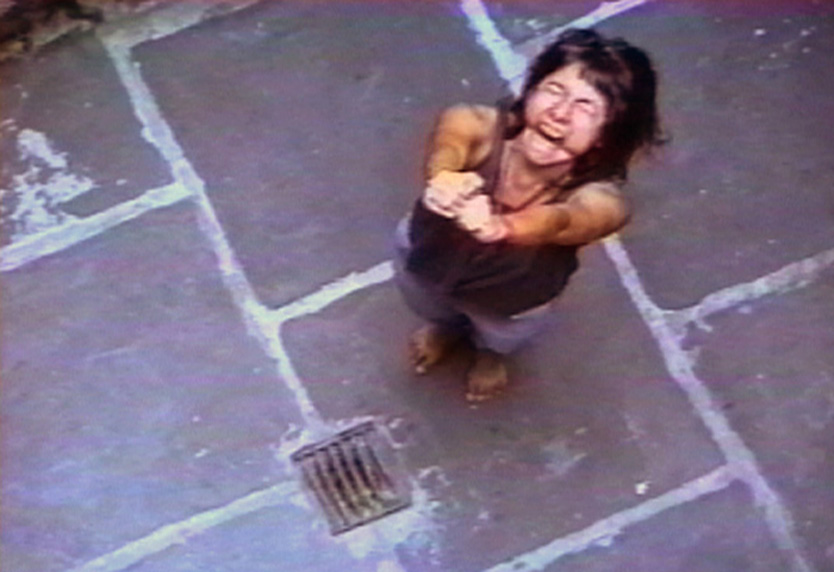
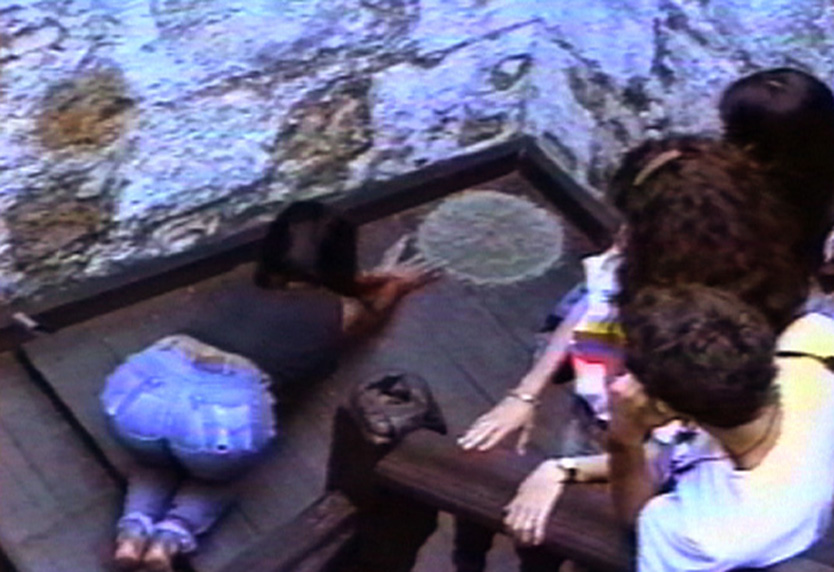
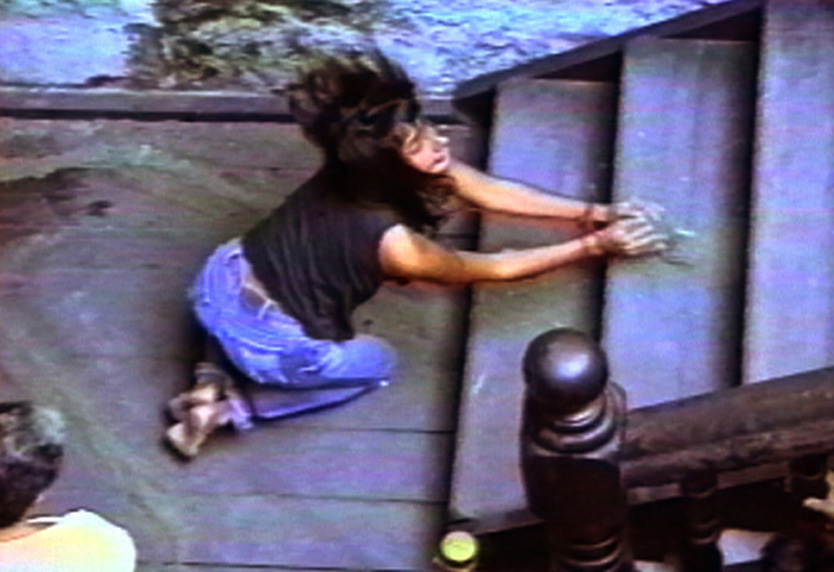
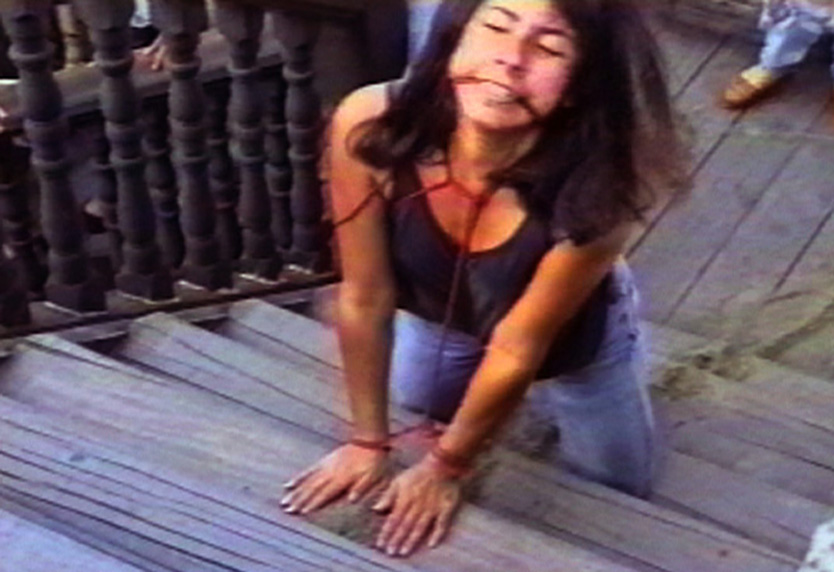
Belmore moved a pile of dirt up a long staircase, stair by stair, in a state of desperate frenzy. Dirt is lost at every stage and it is not at all certain that any of it will make it to the landing at the top of the stairs. The title of the piece reveals its intention to have the viewer experience the piece as the struggle of Indigenous people to reclaim their territories and culture.
Jolene Rickard, Rebecca Belmore: Performing Power, Fountain, Kamloops Art Gallery and Morris and Helen Belkin Art Gallery, 2005
Video credit: Domingo Cisneros